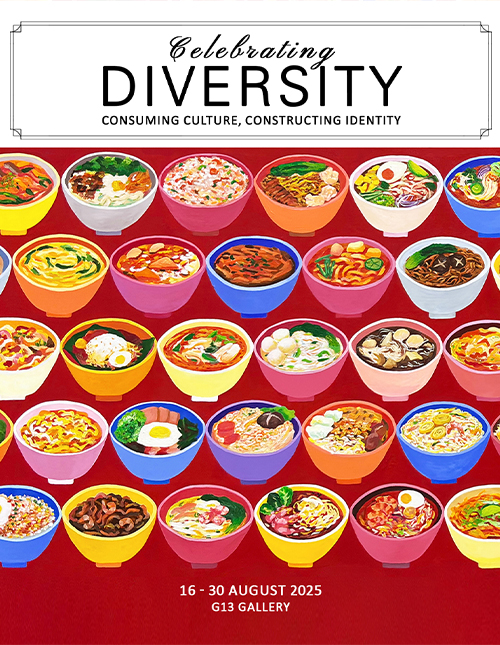
CELEBRATING DIVERSITY
Consuming Culture, Constructing Identity, A Contemporary Art Exhibition on Food and Social Imagination
16 - 30 AUGUST 2025
In conjunction with Malaysia’s Merdeka month, G13 Gallery proudly presents “Celebrating Diversity: Consuming Culture, Constructing Identity,” a contemporary art exhibition that reimagines the symbolic and emotional power of food as a lens into Malaysian identity, cultural memory and social belonging.
The exhibition responds not only to Malaysia’s rich culinary landscape but also to broader issues of nationalism, migration, and identity formation in our time. Celebrating Diversity asks what it means to come to the table, both physically and metaphorically. It challenges us to reconsider how we consume, remember and connect with one another.
“Celebrating Diversity: Consuming Culture, Constructing Identity” runs from 16 to 30 August 2025 and features 26 artists, ranging from senior to emerging and young practitioners.
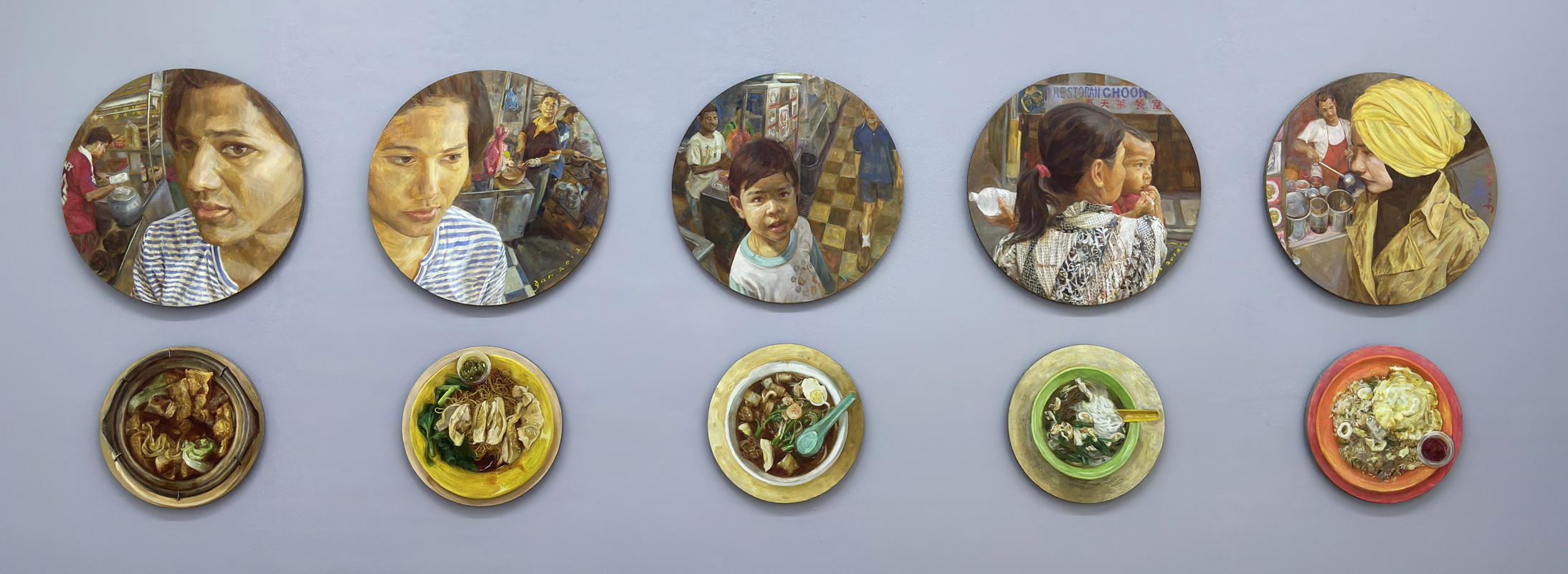
Makan-Makan 1 Malaysia : Myanmar Klang Bah Kut The, Indonesia Hong Kong Wan Tan Mee, Sri Lanka Penang Prawn Mee, Vietnam Ipoh Ho Fun & Thailand Kampung Fried Rice
GAN CHIN LEE
60cm in diameter (Upper) & 40cm in diameter (Lower)
Oil on Canvas
2012
Makan-Makan 1 Malaysia : Myanmar Klang Bah Kut The, Indonesia Hong Kong Wan Tan Mee, Sri Lanka Penang Prawn Mee, Vietnam Ipoh Ho Fun & Thailand Kampung Fried Rice
GAN CHIN LEE
60cm in diameter (Upper) & 40cm in diameter (Lower)
Oil on Canvas
2012
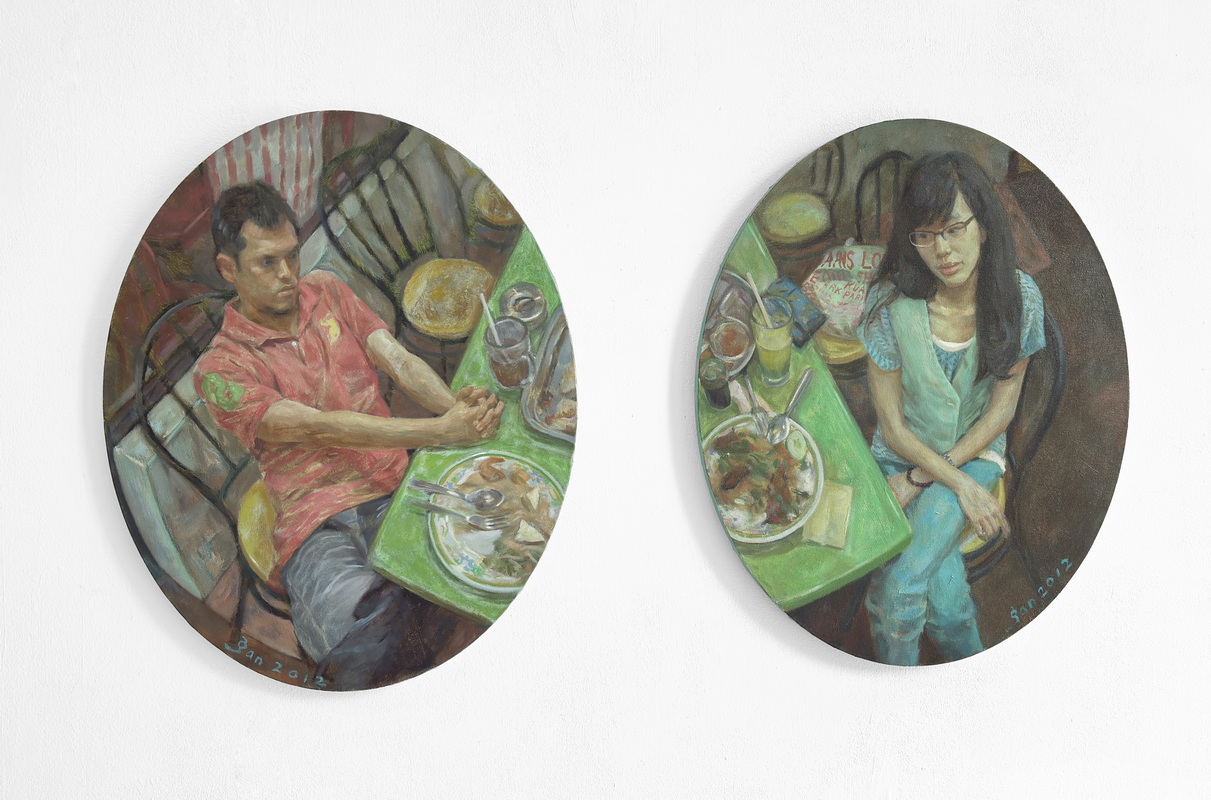
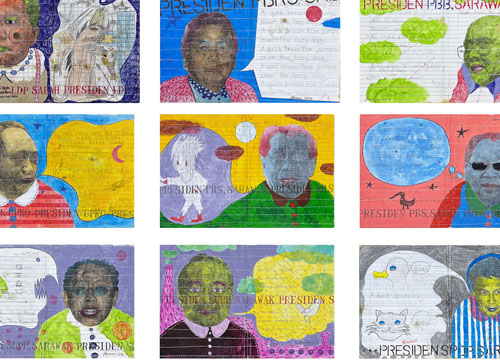

Heroes’ anti Heroes (2014 to 2022), A Menu of Ideology, Promotion of Power
Azizan Paiman
20.5 x 31.5cm
Collage on Exercise Books
36 pieces of artwork were accumulated, painted in 2014, 2020 & 2022
Heroes’ anti Heroes is a visual art project exploring how political beliefs are shaped through cultural consumption rather than facts alone. Politics is treated like cuisine, a mix of emotion, tradition and perception.
Using primary school exercise books as symbolic "plates," the work questions how early education shapes ideological tastes, influenced by both content and the authority that delivers it.
As a cultural observer, I collage fragmented portraits of political leaders from 2014 to 2022. These images blend myth, memory, and symbolism, visual recipes that reflect how power is constructed and consumed.
This project invites viewers to rethink what they've been "fed" politically, who prepared it, and what ingredients were left out. It calls for a more mindful, critical taste of the narratives shaping our collective memory.
Heroes’ anti Heroes (2014 to 2022), A Menu of Ideology, Promotion of Power
Azizan Paiman
20.5 x 31.5cm
Collage on Exercise Books
36 pieces of artwork were accumulated, painted in 2014, 2020 & 2022
Heroes’ anti Heroes is a visual art project exploring how political beliefs are shaped through cultural consumption rather than facts alone. Politics is treated like cuisine, a mix of emotion, tradition and perception.
Using primary school exercise books as symbolic "plates," the work questions how early education shapes ideological tastes, influenced by both content and the authority that delivers it.
As a cultural observer, I collage fragmented portraits of political leaders from 2014 to 2022. These images blend myth, memory, and symbolism, visual recipes that reflect how power is constructed and consumed.
This project invites viewers to rethink what they've been "fed" politically, who prepared it, and what ingredients were left out. It calls for a more mindful, critical taste of the narratives shaping our collective memory.

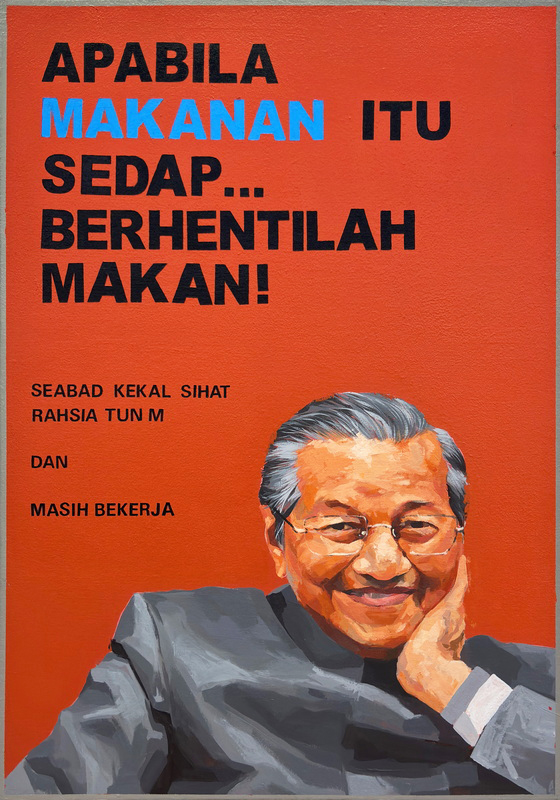
100 Years of Good Health is Everyone's Dream
Khairudin Zainudin
100 x 70cm
Acrylic on Canvas
2025
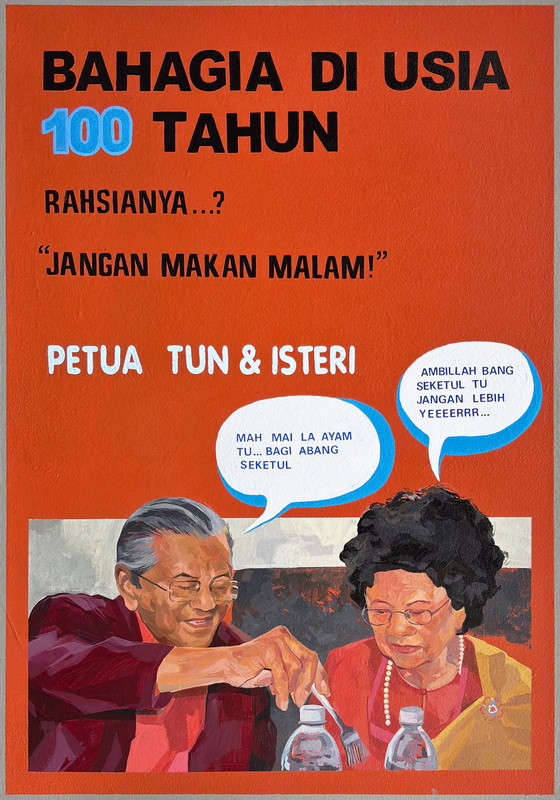
In “100 Years of Good Health is Everyone’s Dream”, Khairudin Zainudin places Tun Dr. Mahathir Mohamad at the heart of his artwork, not just as a prominent political figure, but as a symbol of discipline, longevity and mindful living.
Thematically aligned with Celebrating Diversity, this piece draws inspiration from Tun’s iconic phrase, “Sedap biar berhenti” (Even if it tastes good, know when to stop), which speaks to self-control and conscious eating - values that cut across cultures and traditions.
For the artist, this piece also acts as a personal reminder to always prioritize his health.
100 Years of Good Health is Everyone's Dream
Khairudin Zainudin
100 x 70cm
Acrylic on Canvas
2025
In “100 Years of Good Health is Everyone’s Dream”, Khairudin Zainudin places Tun Dr. Mahathir Mohamad at the heart of his artwork, not just as a prominent political figure, but as a symbol of discipline, longevity and mindful living.
Thematically aligned with Celebrating Diversity, this piece draws inspiration from Tun’s iconic phrase, “Sedap biar berhenti” (Even if it tastes good, know when to stop), which speaks to self-control and conscious eating - values that cut across cultures and traditions.
For the artist, this piece also acts as a personal reminder to always prioritize his health.



Digestion
Gan Tee Sheng
121 x 91cm
Oil on Canvas
2025
In Digestion, the human form is abstracted and surreal, folding into itself in visceral, ambiguous gestures. Rather than depicting a clear narrative, the work invites viewers into an indirect, bodily conversation about identity, memory and transformation.
Here, digestion becomes a metaphor for how culture is absorbed and reconfigured emotionally, physically, and unconsciously. Within Malaysia’s diverse landscape, food represents not just nourishment, but the complex process of cultural mixing and migration.
Resisting easy interpretation, Digestion suggests that celebrating diversity isn’t always harmonious. It can be raw, unsettling, and deeply felt beneath the skin and within the gut.
Digestion
Gan Tee Sheng
121 x 91cm
Oil on Canvas
2025
In Digestion, the human form is abstracted and surreal, folding into itself in visceral, ambiguous gestures. Rather than depicting a clear narrative, the work invites viewers into an indirect, bodily conversation about identity, memory and transformation.
Here, digestion becomes a metaphor for how culture is absorbed and reconfigured emotionally, physically, and unconsciously. Within Malaysia’s diverse landscape, food represents not just nourishment, but the complex process of cultural mixing and migration.
Resisting easy interpretation, Digestion suggests that celebrating diversity isn’t always harmonious. It can be raw, unsettling, and deeply felt beneath the skin and within the gut.


Breakfast
Syed Fakaruddin
122 x 122cm
Acrylic on Canvas
2025
Each component speaks for itself “Celebrating Diversity” in the most familiar way.
The colours show harmony, the lines reveal complexity and the composition reflects the hard work, unity and patriotic spirit required to uphold the Merdeka we cherish today.
A fitting tribute to the spirit of Merdeka Month, through something as humble yet powerful as breakfast.
Breakfast
Syed Fakaruddin
122 x 122cm
Acrylic on Canvas
2025
Each component speaks for itself “Celebrating Diversity” in the most familiar way.
The colours show harmony, the lines reveal complexity and the composition reflects the hard work, unity and patriotic spirit required to uphold the Merdeka we cherish today.
A fitting tribute to the spirit of Merdeka Month, through something as humble yet powerful as breakfast.
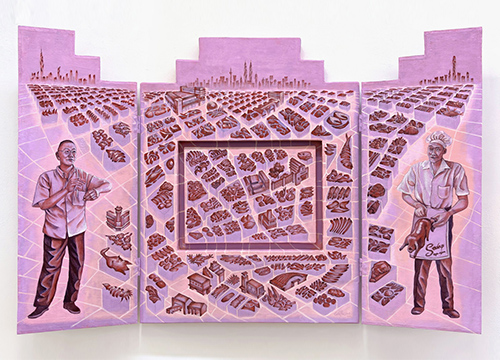
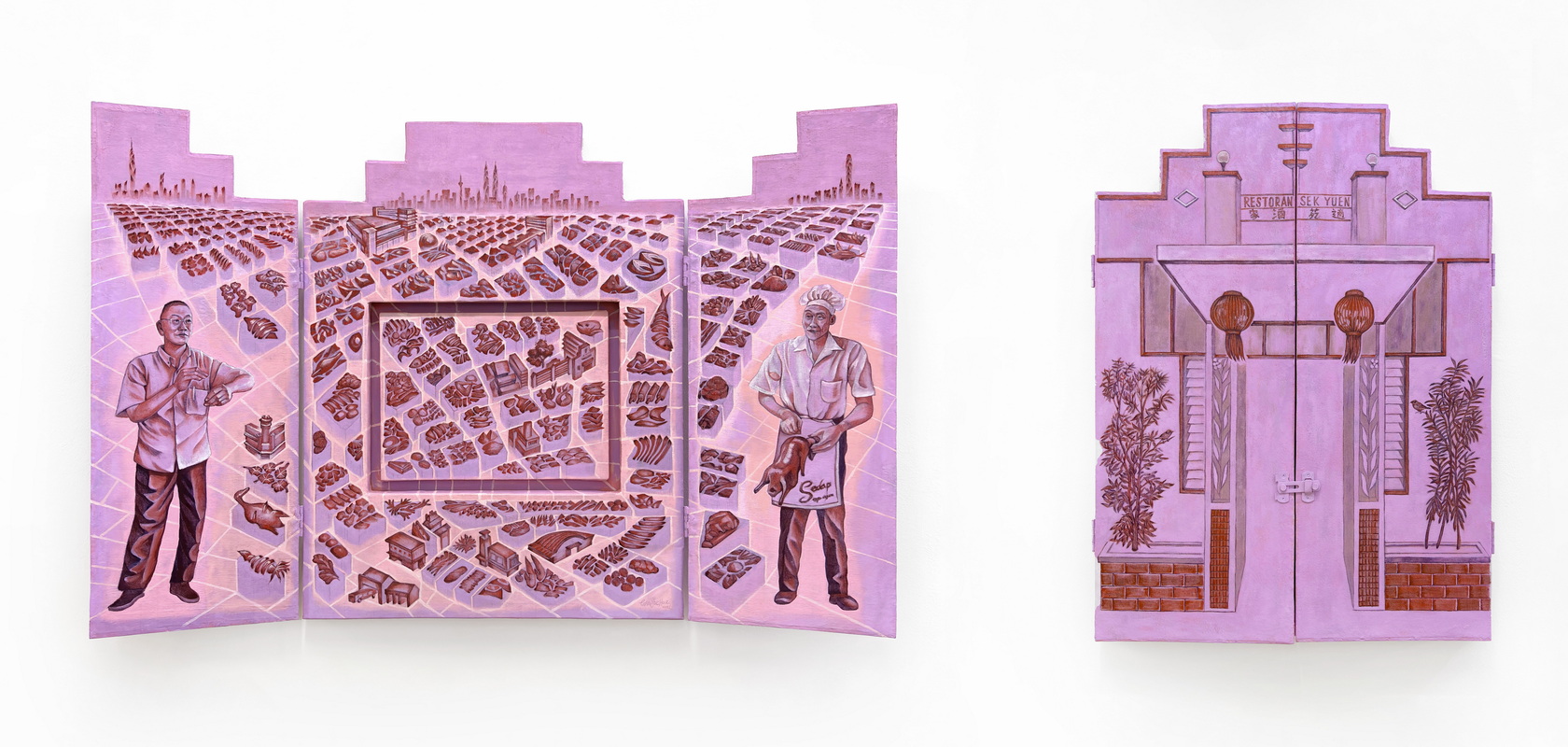
Sek Yuen Culinary Shaping
Gan Sze Hooi
88 x 132cm (Open) & 88 x 65cm (Close)
Oil on Canvas & Pine Wood Frame
2025
Pudu is where I grew up, and in the 1980s it was home to three cinemas. After each movie, my father took us to the lively food street nearby. Among the many stalls and shops, Sek Yuen stood out as a place for celebrations and family gatherings.
The red and pink painting depicts Sek Yuen’s art deco pre-war building on Jalan Pudu. Founded in 1948, its name means “a suitable place for gathering,” and it is likely the only restaurant in Kuala Lumpur to operate for over 70 years. In the painting are Peng So 彭貴松 (left), a third-generation owner whose family once sold noodles before opening the restaurant, and Peng Seng 彭楊星 (right), a second-generation chef. Sek Yuen’s signature Pipa Duck is roasted for 45 minutes, alongside dishes like Eight Treasure Duck and pork knuckle.I am glad they endured the challenges of the pandemic. Today, their food and spirit continue to be savoured, carrying the memories of the past into the hands of the next generation. The story of Sek Yuen is not only about survival but about keeping tradition alive for years to come.
Sek Yuen Culinary Shaping
Gan Sze Hooi
88 x 132cm (Open) & 88 x 65cm (Close)
Oil on Canvas & Pine Wood Frame
2025
Pudu is where I grew up, and in the 1980s it was home to three cinemas. After each movie, my father took us to the lively food street nearby. Among the many stalls and shops, Sek Yuen stood out as a place for celebrations and family gatherings.
The red and pink painting depicts Sek Yuen’s art deco pre-war building on Jalan Pudu. Founded in 1948, its name means “a suitable place for gathering,” and it is likely the only restaurant in Kuala Lumpur to operate for over 70 years. In the painting are Peng So 彭貴松 (left), a third-generation owner whose family once sold noodles before opening the restaurant, and Peng Seng 彭楊星 (right), a second-generation chef. Sek Yuen’s signature Pipa Duck is roasted for 45 minutes, alongside dishes like Eight Treasure Duck and pork knuckle.I am glad they endured the challenges of the pandemic. Today, their food and spirit continue to be savoured, carrying the memories of the past into the hands of the next generation. The story of Sek Yuen is not only about survival but about keeping tradition alive for years to come.
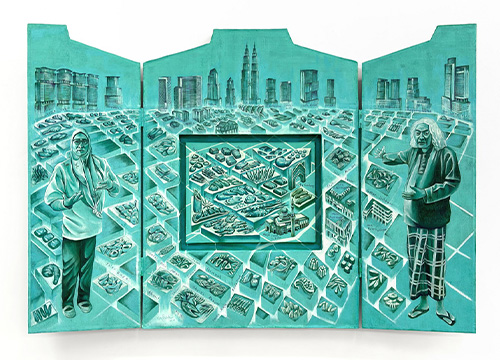
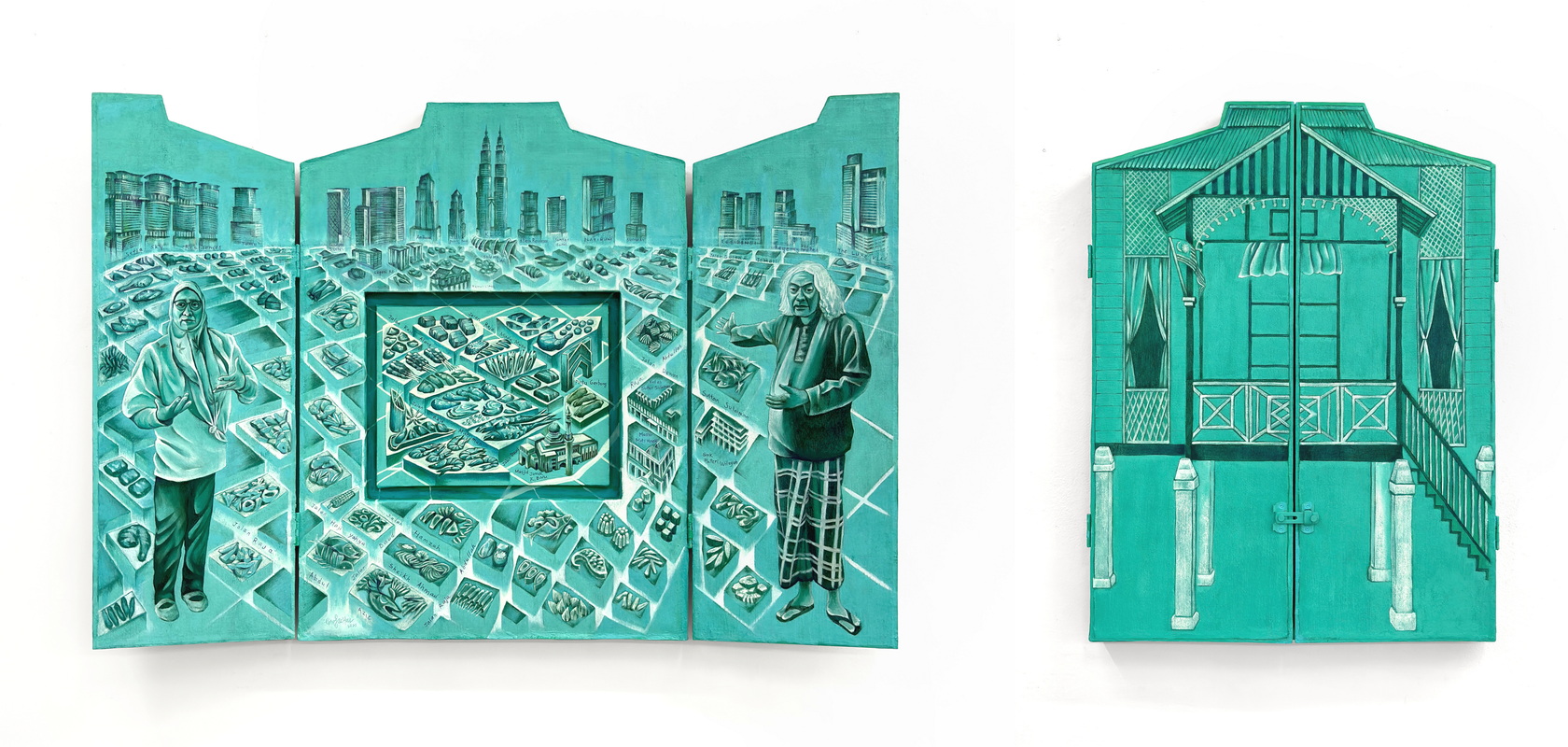
Kampung Baru Culinary Shaping
Gan Sze Hooi
89 x 132cm (Open) & 89 x 66cm (Close)
Oil on Canvas & Pine Wood Frame
2025
I joined a local tour to Kampung Baru many years ago and was struck by both its food and architectural heritage. The teal painting depicts Rumah Limas, an iconic traditional Malay stilt house on Jalan Raja Muda Musa in central Kuala Lumpur, now surrounded by skyscrapers. In the painting are Siti (left) and Fuad Fahmy (right). Fuad, a fourth-generation resident whose great-grandfather was the first imam of Masjid Jamek, works as a village tour guide, welcoming visitors. Siti, his wife, plans to host a “from garden to table” cooking workshop, using ingredients such as lemongrass and coconuts from their garden.
Each night, thousands flock to Jalan Raja Muda Musa for local dishes, satay from Restoran Sahrul, Nasi Lemak Wanjo, Pak Saf Sate Padang, Yati Murtabak Kampung Baru, Putu Bambu Raja Klang and more.
Kampung Baru Culinary Shaping
Gan Sze Hooi
89 x 132cm (Open) & 89 x 66cm (Close)
Oil on Canvas & Pine Wood Frame
2025
I joined a local tour to Kampung Baru many years ago and was struck by both its food and architectural heritage. The teal painting depicts Rumah Limas, an iconic traditional Malay stilt house on Jalan Raja Muda Musa in central Kuala Lumpur, now surrounded by skyscrapers. In the painting are Siti (left) and Fuad Fahmy (right). Fuad, a fourth-generation resident whose great-grandfather was the first imam of Masjid Jamek, works as a village tour guide, welcoming visitors. Siti, his wife, plans to host a “from garden to table” cooking workshop, using ingredients such as lemongrass and coconuts from their garden.
Each night, thousands flock to Jalan Raja Muda Musa for local dishes, satay from Restoran Sahrul, Nasi Lemak Wanjo, Pak Saf Sate Padang, Yati Murtabak Kampung Baru, Putu Bambu Raja Klang and more.
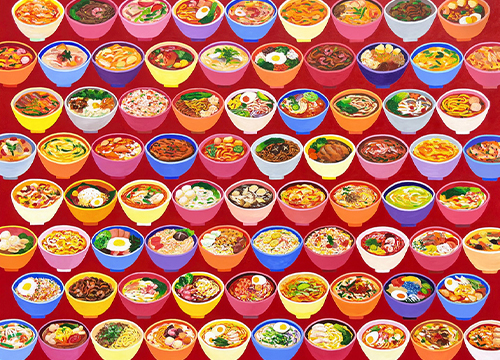
Bowls of Malaysia
Ho Mei Kei
122 x 152cm
Acrylic on Canvas
2025
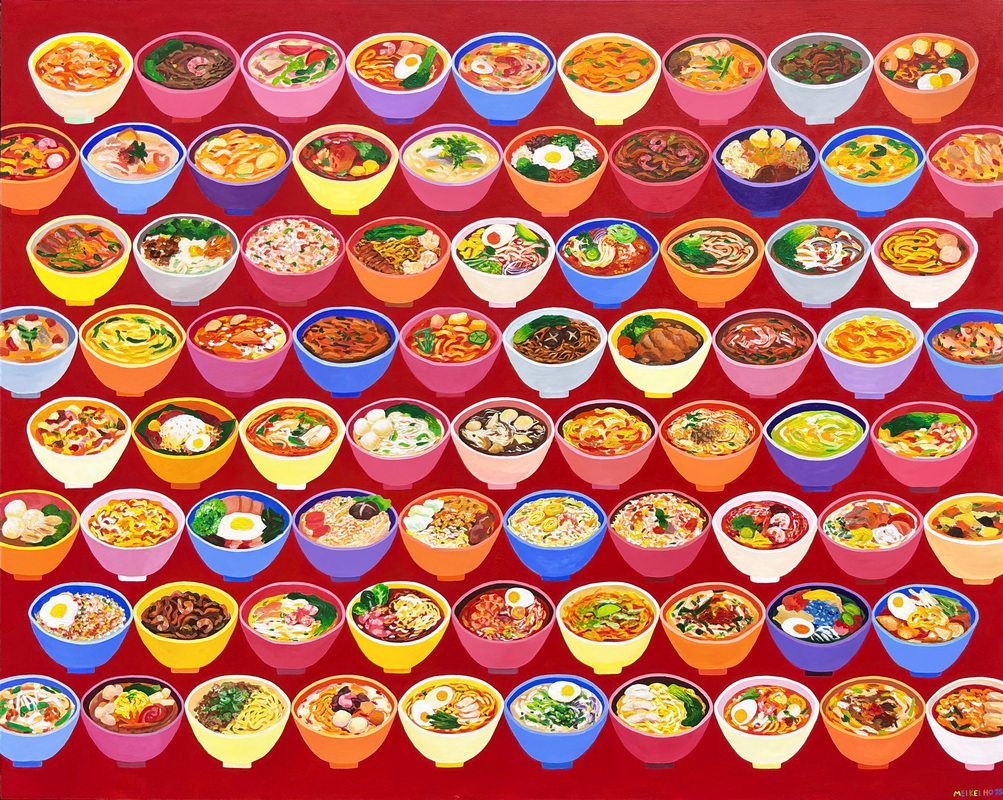
A red table. Plastic chairs. The familiar buzz of voices calling out orders like “Mee Rebus satu!” and “Tambah sambal, boss!” fills the air. The scent of broth, sambal and sizzling garlic lingers. This isn’t just a meal setting. It’s a Malaysian memory.
In Bowls of Malaysia captures a scene familiar to anyone who’s eaten at a local food court. Dozens of noodle bowls, each full of colour and flavour, are laid out like a visual feast. From Curry Laksa and Kolo Mee to Tom Yum, Maggi Goreng and Penang Hokkien Mee, every bowl tells its own story. This artwork is more than just a celebration of noodles. It’s a tribute to everyday life. The red table, often seen in hawker stalls and kopitiams around the country, Each bowl is a little piece of Malaysia. A mix of flavours, cultures and comfort. Just like how we live and eat here, side by side. These aren’t just noodles. They are memories, cravings, and stories we have grown up with.
Bowls of Malaysia
Ho Mei Kei
122 x 152cm
Acrylic on Canvas
2025
A red table. Plastic chairs. The familiar buzz of voices calling out orders like “Mee Rebus satu!” and “Tambah sambal, boss!” fills the air. The scent of broth, sambal and sizzling garlic lingers. This isn’t just a meal setting. It’s a Malaysian memory.
In Bowls of Malaysia captures a scene familiar to anyone who’s eaten at a local food court. Dozens of noodle bowls, each full of colour and flavour, are laid out like a visual feast. From Curry Laksa and Kolo Mee to Tom Yum, Maggi Goreng and Penang Hokkien Mee, every bowl tells its own story. This artwork is more than just a celebration of noodles. It’s a tribute to everyday life. The red table, often seen in hawker stalls and kopitiams around the country, Each bowl is a little piece of Malaysia. A mix of flavours, cultures and comfort. Just like how we live and eat here, side by side. These aren’t just noodles. They are memories, cravings, and stories we have grown up with.

Blocks of Kuih (Kuih Muih Series)
Ho Mei Kei
80 x 60cm
Acrylic on Canvas
2025
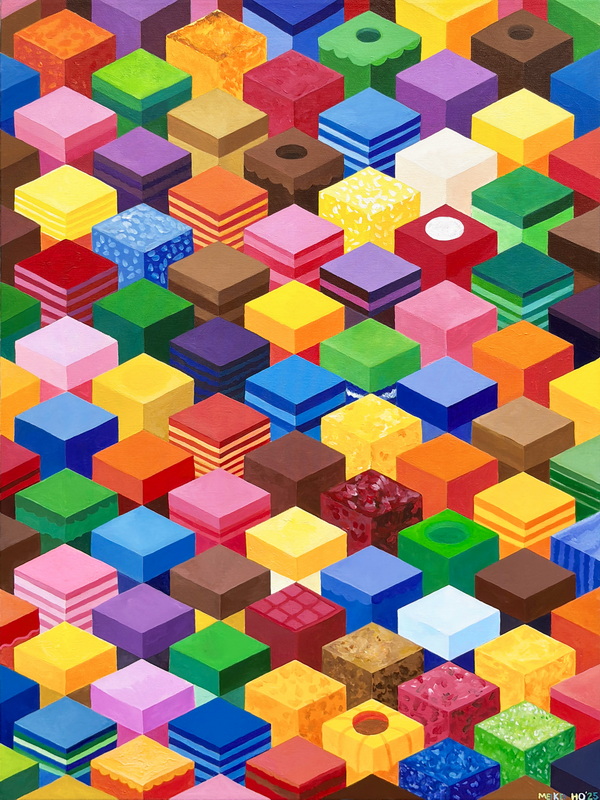
In Blocks of Kuih, part of the Kuih Muih Series, artist Ho Mei Kei reimagines Malaysia’s traditional treats through a playful Pop Art lens. Presented in bold colours and clean, structured forms, each kuih stands like a proud recruit in a cheerful, sugar-coated formation.
The work is fun, familiar, and a little quirky, much like the nation it reflects. Through this vibrant arrangement, Ho Mei Kei invites viewers to rediscover the rich variety and cultural charm of kuih muih. Each block is more than a dessert; it’s a celebration of joy, identity, and the everyday sweetness shared by Malaysians across generations.
Blocks of Kuih (Kuih Muih Series)
Ho Mei Kei
80 x 60cm
Acrylic on Canvas
2025
In Blocks of Kuih, part of the Kuih Muih Series, artist Ho Mei Kei reimagines Malaysia’s traditional treats through a playful Pop Art lens. Presented in bold colours and clean, structured forms, each kuih stands like a proud recruit in a cheerful, sugar-coated formation.
The work is fun, familiar, and a little quirky, much like the nation it reflects. Through this vibrant arrangement, Ho Mei Kei invites viewers to rediscover the rich variety and cultural charm of kuih muih. Each block is more than a dessert; it’s a celebration of joy, identity, and the everyday sweetness shared by Malaysians across generations.
Honey Lemon
Kow Leong Kiang
122 x 122cm
Oil on Canvas
2025
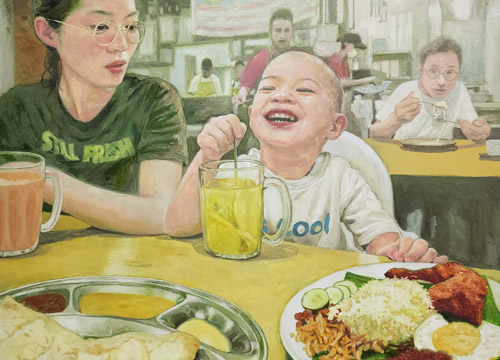
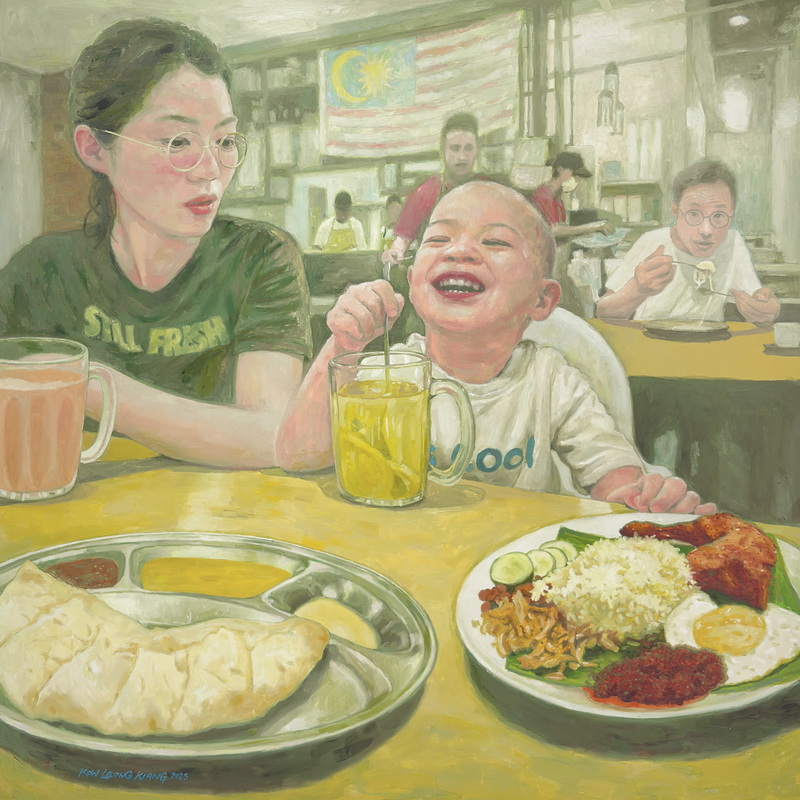
Honey Lemon by Kow Leong Kiang captures a warm family scene in a kopitiam, where everyday moments reveal deeper reflections on belonging and identity. Iconic dishes like nasi lemak and roti canai anchor the painting in Malaysia’s shared culture, while Kow’s deliberate placement of himself in the background adds a playful sense of distance and self-awareness. The work suggests that diversity is not just celebrated in grand gestures, but lived daily at the table in food, family and familiar spaces.
Honey Lemon
Kow Leong Kiang
122 x 122cm
Oil on Canvas
2025
Honey Lemon by Kow Leong Kiang captures a warm family scene in a kopitiam, where everyday moments reveal deeper reflections on belonging and identity. Iconic dishes like nasi lemak and roti canai anchor the painting in Malaysia’s shared culture, while Kow’s deliberate placement of himself in the background adds a playful sense of distance and self-awareness. The work suggests that diversity is not just celebrated in grand gestures, but lived daily at the table in food, family and familiar spaces.


Garlics & Beetle
Chong Ai Lei
120 x 120cm
Oil on Canvas
2025
Garlic is an indispensable ingredient in the kitchen. Although it is not the protagonist, it is the soul of many dishes. It exudes a unique charm, can stimulate the taste buds, and activate people's entire taste system. It is also beneficial to health, and has the actual effect of killing viruses and inhibiting bacteria. The outer layer of garlic is a layer of thin scales, the colour changes from white to light purple, as if the garlic is covered with a dreamy neon dress. In Chinese, the homonym of "garlic蒜” is "suan算", which means being able to speak and calculate. It symbolizes getting rich and bringing endless good luck and wisdom to the owner.
Garlics & Beetle
Chong Ai Lei
120 x 120cm
Oil on Canvas
2025
Garlic is an indispensable ingredient in the kitchen. Although it is not the protagonist, it is the soul of many dishes. It exudes a unique charm, can stimulate the taste buds, and activate people's entire taste system. It is also beneficial to health, and has the actual effect of killing viruses and inhibiting bacteria. The outer layer of garlic is a layer of thin scales, the colour changes from white to light purple, as if the garlic is covered with a dreamy neon dress. In Chinese, the homonym of "garlic蒜” is "suan算", which means being able to speak and calculate. It symbolizes getting rich and bringing endless good luck and wisdom to the owner.
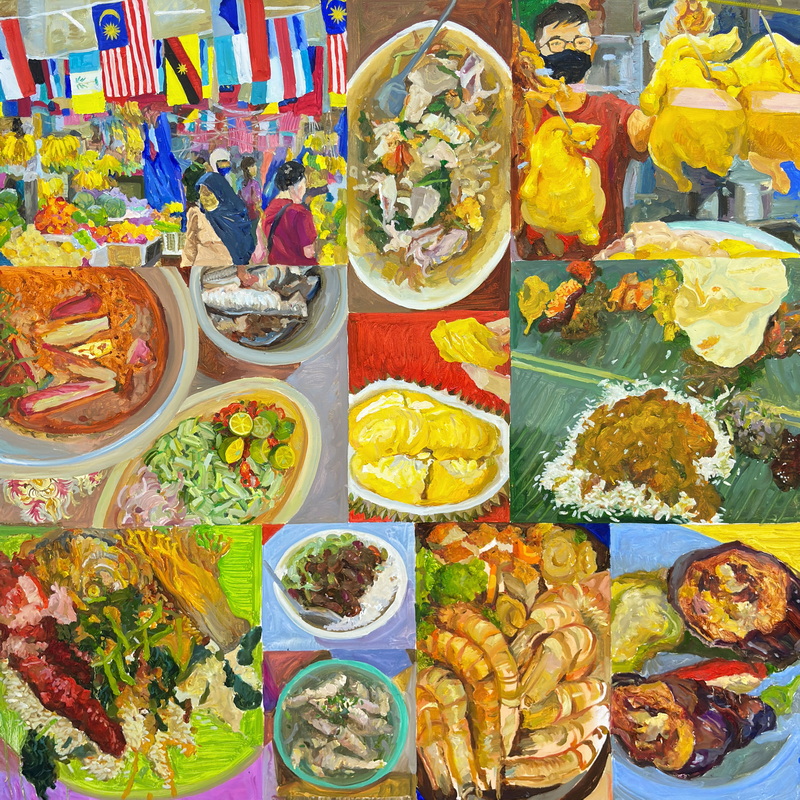
"Nakaakan Ko Noh? A Sabahan Eats his way from Kota Kinabalu to Kangar"
Sack Tin Lim
122 x 122cm
Oil on Canvas
2025
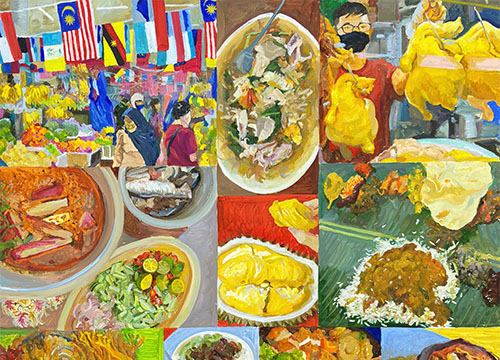
Migration transformed the artist’s relationship with food. Moving from Sabah to West Malaysia in 2011 opened their world to a kaleidoscope of flavors, dishes from every corner of the country, each cooked, layered and complex. Here, the raw and the cooked stand in dialogue: the richness of the present set against the unprocessed memory of the past. That memory begins with a pasar tamu scene from Sabah, a vibrant marketplace where food exists in its rawest form. For the artist, it is a repository of memory, a sensory anchor to home, held with deep nostalgia. The raw produce speaks of memory in its pure form; the cooked dishes embody experiences shaped through migration. Together, they show how the past remains vivid even as the present deepens.
"Nakaakan Ko Noh? A Sabahan Eats his way from Kota Kinabalu to Kangar"
Sack Tin Lim
122 x 122cm
Oil on Canvas
2025
Migration transformed the artist’s relationship with food. Moving from Sabah to West Malaysia in 2011 opened their world to a kaleidoscope of flavors, dishes from every corner of the country, each cooked, layered and complex. Here, the raw and the cooked stand in dialogue: the richness of the present set against the unprocessed memory of the past. That memory begins with a pasar tamu scene from Sabah, a vibrant marketplace where food exists in its rawest form. For the artist, it is a repository of memory, a sensory anchor to home, held with deep nostalgia. The raw produce speaks of memory in its pure form; the cooked dishes embody experiences shaped through migration. Together, they show how the past remains vivid even as the present deepens.
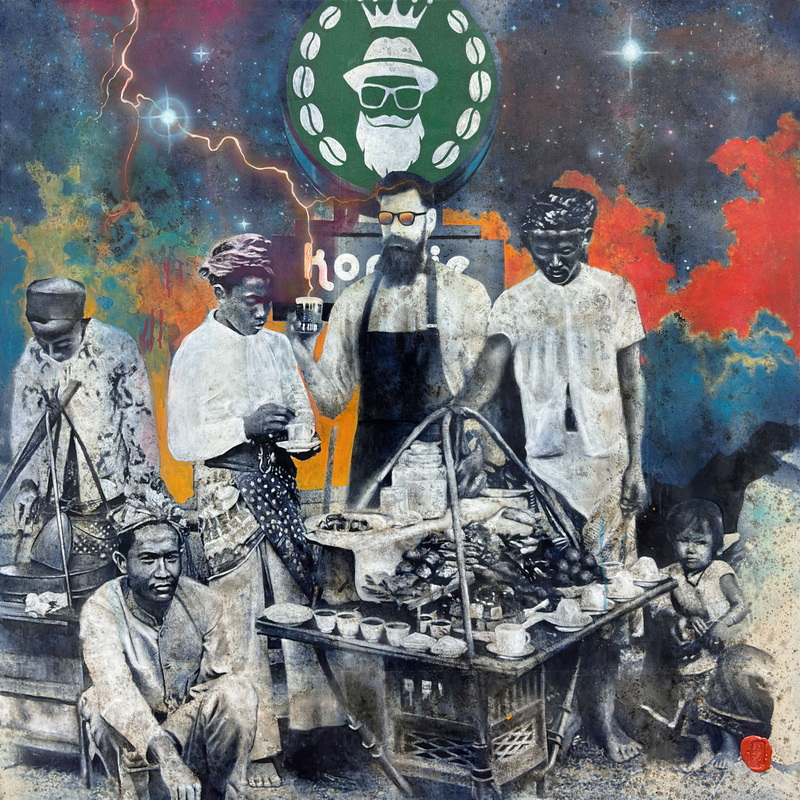
Toekang Koppie
Amar Shahid
138 x 138cm
Cyanotype & Mixed Media on Canvas
2025
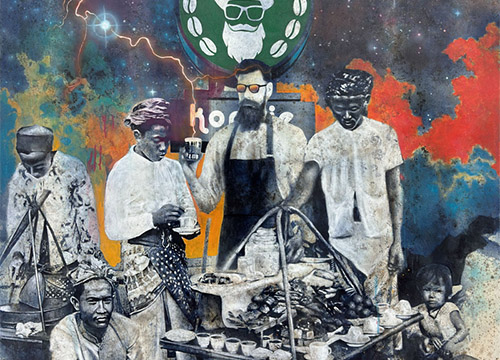
A playful jab on the commercialisation of culture through drug-infused beverage, coffee had been a staple instrument on the tug of war between capitalism and culture. The image is an adaptation of historical colonial photos that documented street merchants peddling coffee and snacks in the Dutch east indies.
In recent times, coffee and similar beverages are currently at the forefront of the debate between protectionism and global prosperity, with foreign giants battling for market share with local brands, echoing a geopolitical sentiment over a fittingly stimulating drink.
Toekang Koppie
Amar Shahid
138 x 138cm
Cyanotype & Mixed Media on Canvas
2025
A playful jab on the commercialisation of culture through drug-infused beverage, coffee had been a staple instrument on the tug of war between capitalism and culture. The image is an adaptation of historical colonial photos that documented street merchants peddling coffee and snacks in the Dutch east indies.
In recent times, coffee and similar beverages are currently at the forefront of the debate between protectionism and global prosperity, with foreign giants battling for market share with local brands, echoing a geopolitical sentiment over a fittingly stimulating drink.
More Than Just Snacks
Yuki Tham
150 x 150cm
Oil on Canvas
2025
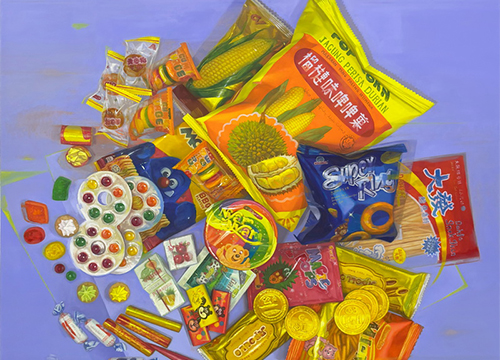
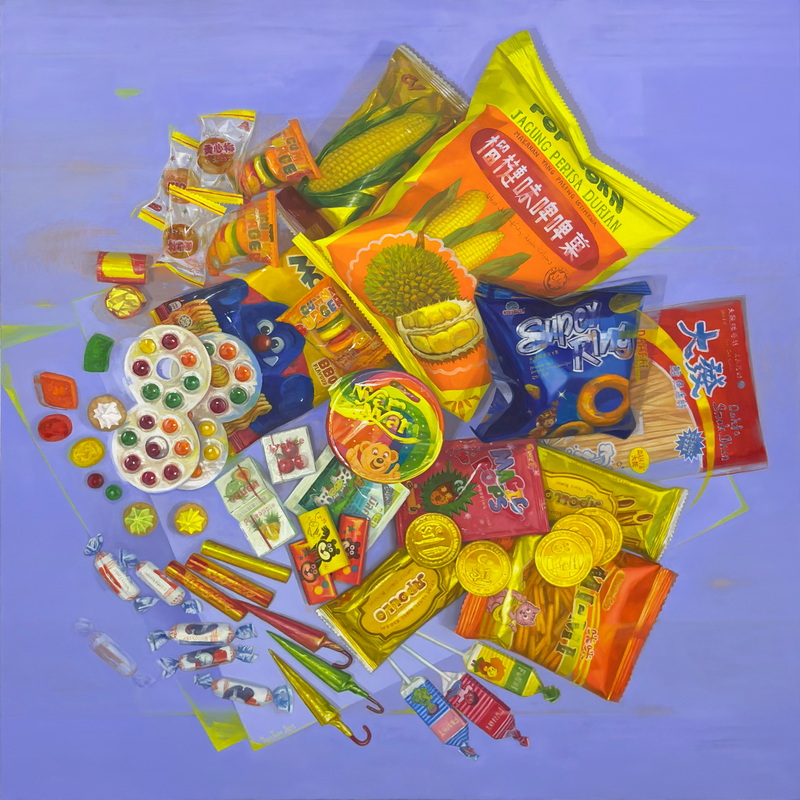
For many Malaysians, snacks aren’t just food. They’re childhood in a packet. Bright colours, bold flavours, and the joy of picking your favourite treat from the corner shop were tiny thrills that tasted like freedom. These crunchy, sweet, and salty bites still take us back. One chew and we’re kids again.
More Than Just Snacks
Yuki Tham
150 x 150cm
Oil on Canvas
2025
For many Malaysians, snacks aren’t just food. They’re childhood in a packet. Bright colours, bold flavours, and the joy of picking your favourite treat from the corner shop were tiny thrills that tasted like freedom. These crunchy, sweet, and salty bites still take us back. One chew and we’re kids again.
I Got This from My Neighbour
Haziq Syawal
140 x 110cm
Acrylic & Oil on Canvas
2025
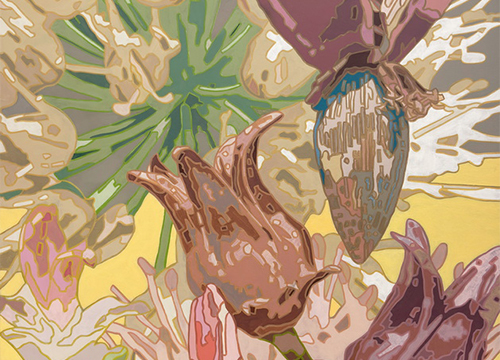
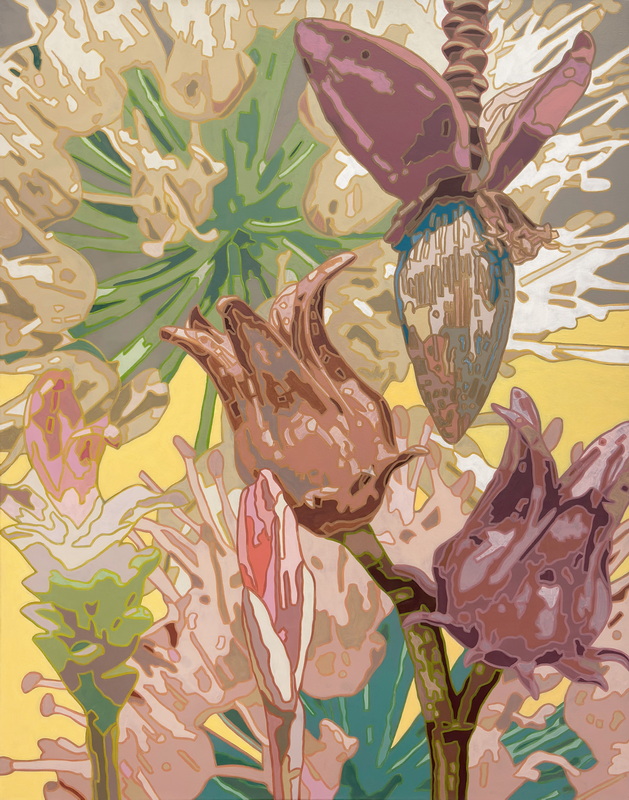
“I Got This from My Neighbour” captures the quiet beauty of a shared plant, a small but meaningful gesture that reflects the enduring spirit of jiran tetangga in Malaysia. In today’s fast-moving world, where genuine connection is often overlooked, such exchanges remind us of the quiet care that still exists between neighbours. The artwork speaks to how thoughtfulness and trust can grow from simple acts. What begins at home or across the fence has the power to inspire a more caring and connected community.
I Got This from My Neighbour
Haziq Syawal
140 x 110cm
Acrylic & Oil on Canvas
2025
“I Got This from My Neighbour” captures the quiet beauty of a shared plant, a small but meaningful gesture that reflects the enduring spirit of jiran tetangga in Malaysia. In today’s fast-moving world, where genuine connection is often overlooked, such exchanges remind us of the quiet care that still exists between neighbours. The artwork speaks to how thoughtfulness and trust can grow from simple acts. What begins at home or across the fence has the power to inspire a more caring and connected community.


Junjungan Kemerdekaan
Fawwaz Sukri
122 x 92cm
Acrylic on Canvas
2025
The title "Junjungan Kemerdekaan" plays on the word “Junjung” (to carry or uphold with respect) and reflects the spirit of upholding independence with pride and unity. Using bold colours, nostalgic visuals, and layered imagery, the artwork captures fragments of Malaysian life, from the clang of metal cups in kopitiams to moments shared over a glass of teh tarik.
This piece celebrates the everyday warmth, unity, and joy that shape our identity, especially during Merdeka month, when our diversity blends like tea and milk into something uniquely Malaysian.
"Junjungan Kemerdekaan" invites us to reflect, smile, and raise a mug to our heritage and the simple things that bring us together.
Junjungan Kemerdekaan
Fawwaz Sukri
122 x 92cm
Acrylic on Canvas
2025
The title "Junjungan Kemerdekaan" plays on the word “Junjung” (to carry or uphold with respect) and reflects the spirit of upholding independence with pride and unity. Using bold colours, nostalgic visuals, and layered imagery, the artwork captures fragments of Malaysian life, from the clang of metal cups in kopitiams to moments shared over a glass of teh tarik.
This piece celebrates the everyday warmth, unity, and joy that shape our identity, especially during Merdeka month, when our diversity blends like tea and milk into something uniquely Malaysian.
"Junjungan Kemerdekaan" invites us to reflect, smile, and raise a mug to our heritage and the simple things that bring us together.


Hot Day
Nik Mohd Shahfiz
140 x 120cm
Oil on Horizontally-cut Canvas Mounted on Canvas
2025
This artwork reimagines a familiar moment of togetherness, a traditional gathering around food through deliberate, rhythmic horizontal cuts made across a painted canvas. At the center, a bowl of ais batu campur (ABC) stands as a symbol of culture, memory and shared experience. The resulting lines introduce a new visual rhythm that reflects both contemporary aesthetics and the layered nature of collective memory. These cuts do not destroy the image but instead reshape it, offering a fresh perspective on how continuity can emerge through transformation. The act of layering and restructuring invites reflection on how tradition and modernity can coexist within a harmonious visual language.
Hot Day
Nik Mohd Shahfiz
140 x 120cm
Oil on Horizontally-cut Canvas Mounted on Canvas
2025
This artwork reimagines a familiar moment of togetherness, a traditional gathering around food through deliberate, rhythmic horizontal cuts made across a painted canvas. At the center, a bowl of ais batu campur (ABC) stands as a symbol of culture, memory and shared experience. The resulting lines introduce a new visual rhythm that reflects both contemporary aesthetics and the layered nature of collective memory. These cuts do not destroy the image but instead reshape it, offering a fresh perspective on how continuity can emerge through transformation. The act of layering and restructuring invites reflection on how tradition and modernity can coexist within a harmonious visual language.


Rempah Ratus, Aroma Malaysia
Izzuddin Basiron
122 x 153cm
Mixed Media on Canvas
2025
Rempah Ratus, Aroma Malaysia" draws inspiration from the vibrant TTDI Market, a beloved neighbourhood hub in Taman Tun. While the painting focuses solely on the market’s architecture, its quiet form recalls the vivid colours of fresh produce, the aroma of spices, the chatter of vendors and the steady rhythm of daily life. The title underscores the market’s role as the foundation of every Malaysian kitchen where diverse ingredients, like our people, come together to create rich, layered flavours.
Rempah Ratus, Aroma Malaysia
Izzuddin Basiron
122 x 153cm
Mixed Media on Canvas
2025
Rempah Ratus, Aroma Malaysia" draws inspiration from the vibrant TTDI Market, a beloved neighbourhood hub in Taman Tun. While the painting focuses solely on the market’s architecture, its quiet form recalls the vivid colours of fresh produce, the aroma of spices, the chatter of vendors and the steady rhythm of daily life. The title underscores the market’s role as the foundation of every Malaysian kitchen where diverse ingredients, like our people, come together to create rich, layered flavours.


No Photo, No Makan
Wong Ming Hao
90 x 120cm
Acrylic, Watercolour & Colour Pencil
2025
In Malaysia, we don’t just eat; we curate our meals. This artwork captures a familiar and funny ritual: before a single bite is taken, phones rise like paparazzi over a red carpet of nasi lemak, laksa, roti canai, and cendol.
A celebration of Malaysia’s glorious food diversity, this piece also pokes fun at our modern makan culture where every meal becomes a photo opportunity and every plate a chance for content. The vibrant red background echoes the passion we have for food, while the sea of hands holding phones reflects our shared habit of saying, “Eh, jangan makan dulu!” “等一下,不要吃先!”
Because here, the rule is simple: no photo, no makan.
No Photo, No Makan
Wong Ming Hao
90 x 120cm
Acrylic, Watercolour & Colour Pencil
2025
In Malaysia, we don’t just eat; we curate our meals. This artwork captures a familiar and funny ritual: before a single bite is taken, phones rise like paparazzi over a red carpet of nasi lemak, laksa, roti canai, and cendol.
A celebration of Malaysia’s glorious food diversity, this piece also pokes fun at our modern makan culture where every meal becomes a photo opportunity and every plate a chance for content. The vibrant red background echoes the passion we have for food, while the sea of hands holding phones reflects our shared habit of saying, “Eh, jangan makan dulu!” “等一下,不要吃先!”
Because here, the rule is simple: no photo, no makan.
Fragile Assets
Noor Zahran
82 x 132cm
Coloured Pencil on Paper
2025
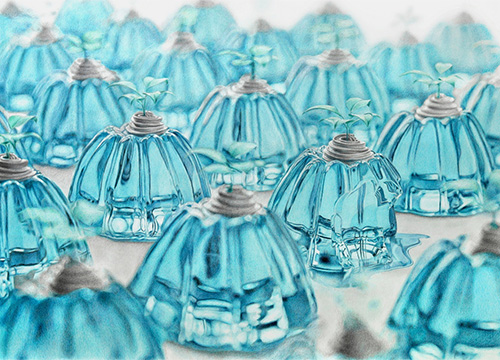
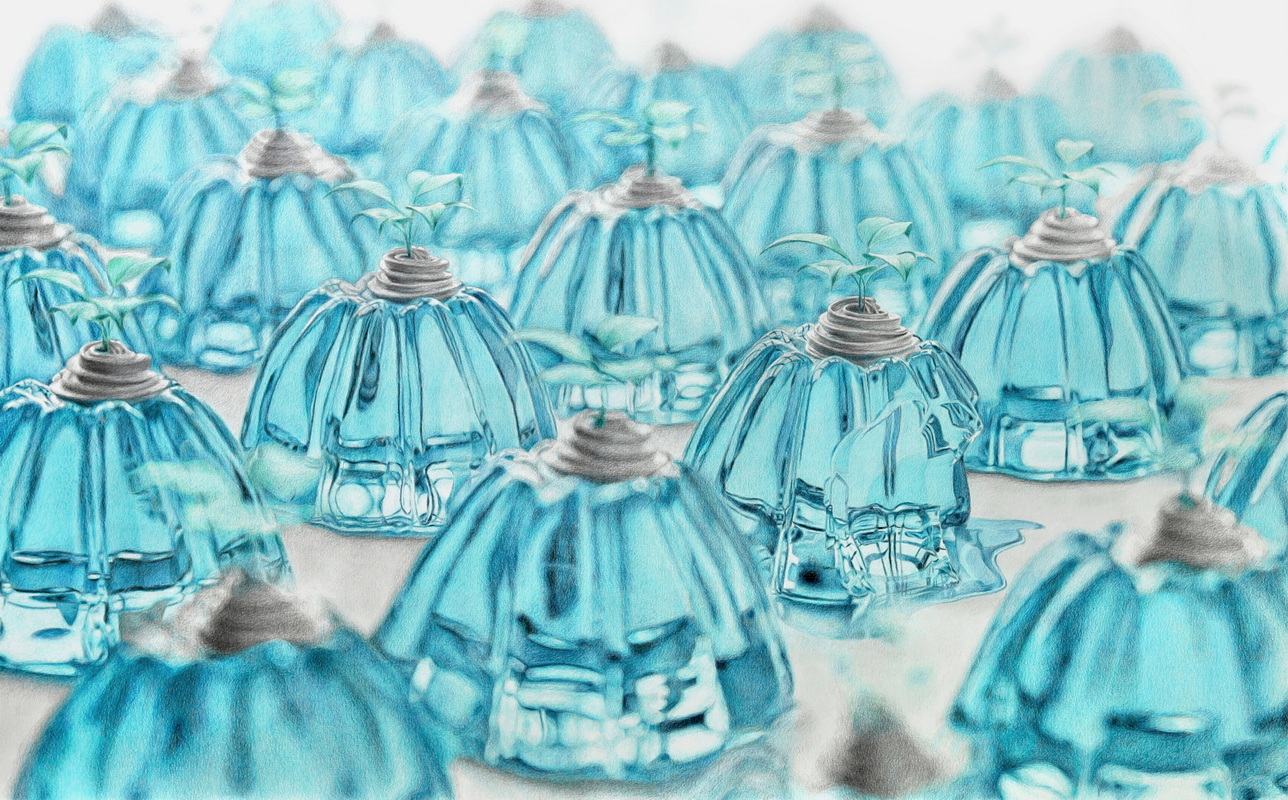
Agar agar pudding, a colourful dessert familiar across Malaysian cultures, becomes a metaphor for property ownership and the fragility of economic aspiration. Each pudding represents a personal asset, while the seedling atop symbolises hope and growth.
A single broken pudding, spilling its contents, hints at the emotional and financial strain involved in the pursuit of stability. By choosing a sweet, joyful treat often shared in celebration, the artist highlights how deeply social and economic values are embedded in everyday consumption. Fragile Assets playfully questions how cultural identity and personal worth are shaped not only by what we own, but what we hope to own, even through something as symbolic as dessert.
Fragile Assets
Noor Zahran
82 x 132cm
Coloured Pencil on Paper
2025
Agar agar pudding, a colourful dessert familiar across Malaysian cultures, becomes a metaphor for property ownership and the fragility of economic aspiration. Each pudding represents a personal asset, while the seedling atop symbolises hope and growth.
A single broken pudding, spilling its contents, hints at the emotional and financial strain involved in the pursuit of stability. By choosing a sweet, joyful treat often shared in celebration, the artist highlights how deeply social and economic values are embedded in everyday consumption. Fragile Assets playfully questions how cultural identity and personal worth are shaped not only by what we own, but what we hope to own, even through something as symbolic as dessert.
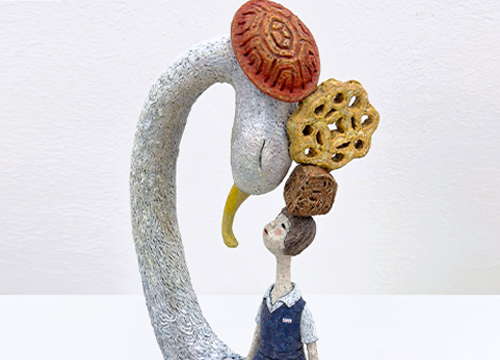
The Taste Within I
(Variety Angles)
Yiji Lee Sou Ven
38(H) x 30(W) x 14.5(D)cm
Stone Powder Clay & Mixed Media
2025
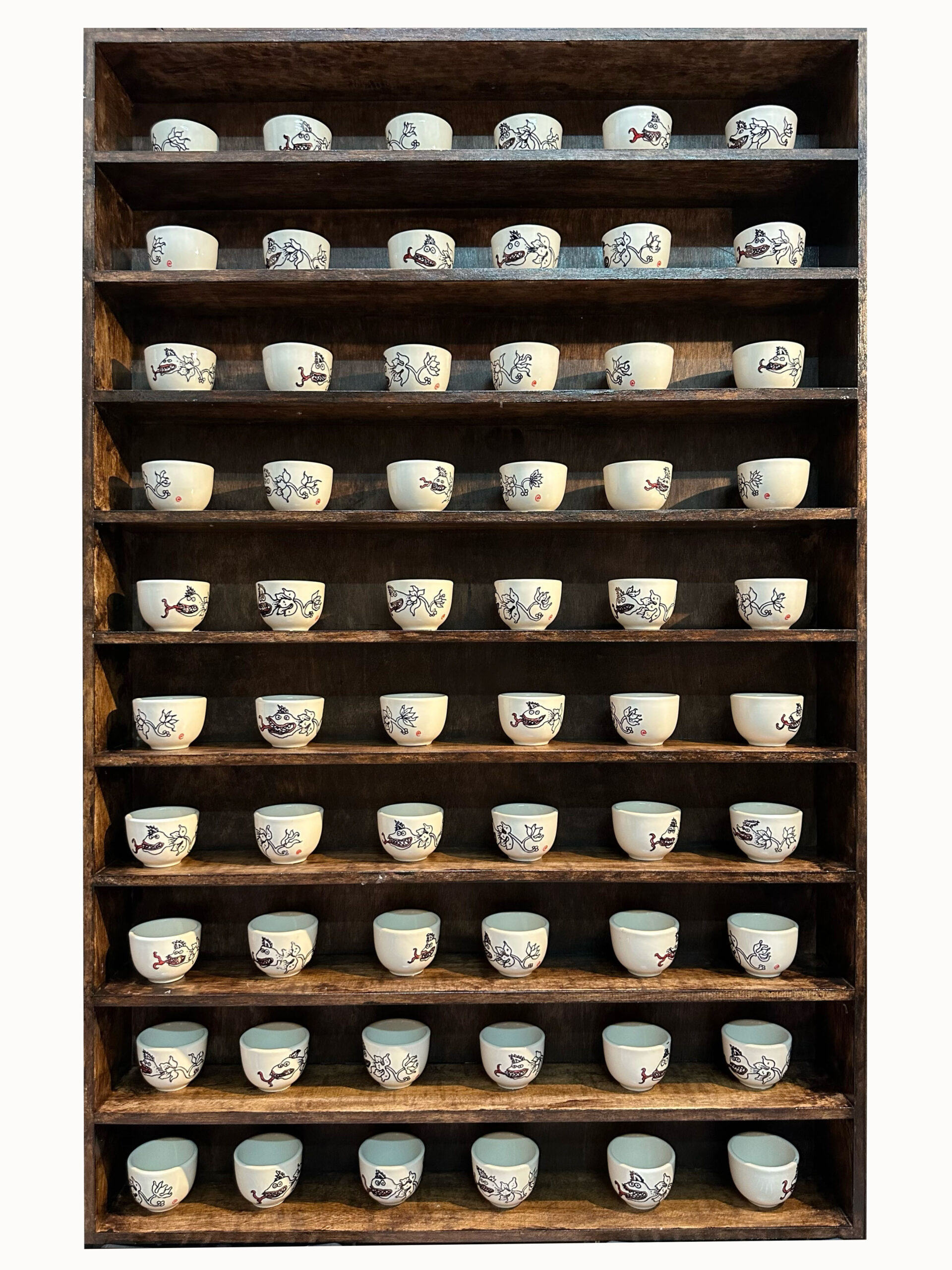
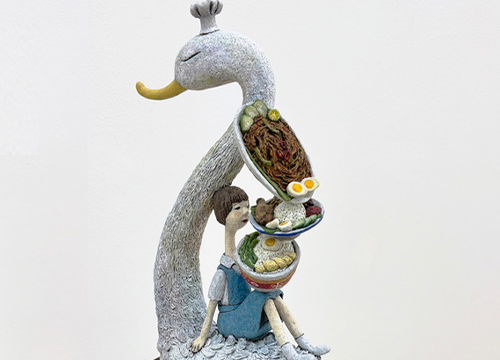
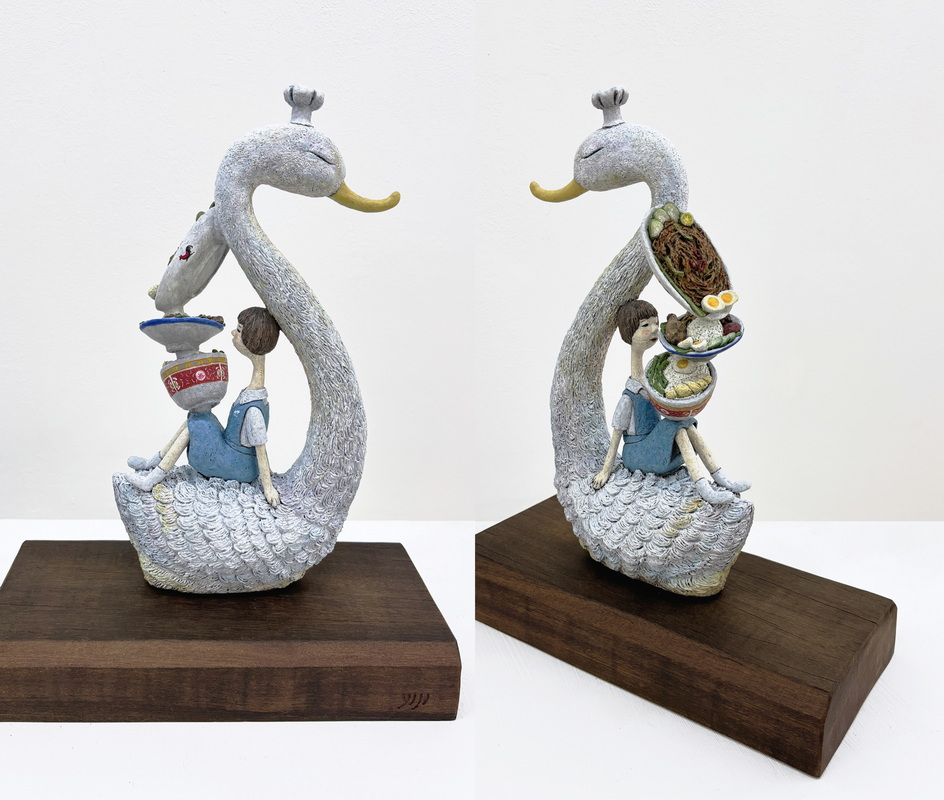
Yiji reflects on food as a multigenerational symbol of love, a quiet and everyday ritual that preserves both identity and intimacy. Through the tactile medium of ceramics, she gives material form to these memories, inviting reflection on how personal narratives shape and enrich Malaysia’s collective cultural landscape. The labour-intensive and deliberate process of sculpting mirrors the care and intention found in food preparation. Both are acts of preservation that safeguard Chinese culinary heritage. Once rooted in familial tradition, these foods have now become a shared part of the Malaysian palate, underscoring how personal identity and collective culture are constantly evolving, blending and being redefined.
The Taste Within I
(Variety Angles)
Yiji Lee Sou Ven
38(H) x 30(W) x 14.5(D)cm
Stone Powder Clay & Mixed Media
2025
Yiji reflects on food as a multigenerational symbol of love, a quiet and everyday ritual that preserves both identity and intimacy. Through the tactile medium of ceramics, she gives material form to these memories, inviting reflection on how personal narratives shape and enrich Malaysia’s collective cultural landscape. The labour-intensive and deliberate process of sculpting mirrors the care and intention found in food preparation. Both are acts of preservation that safeguard Chinese culinary heritage. Once rooted in familial tradition, these foods have now become a shared part of the Malaysian palate, underscoring how personal identity and collective culture are constantly evolving, blending and being redefined.
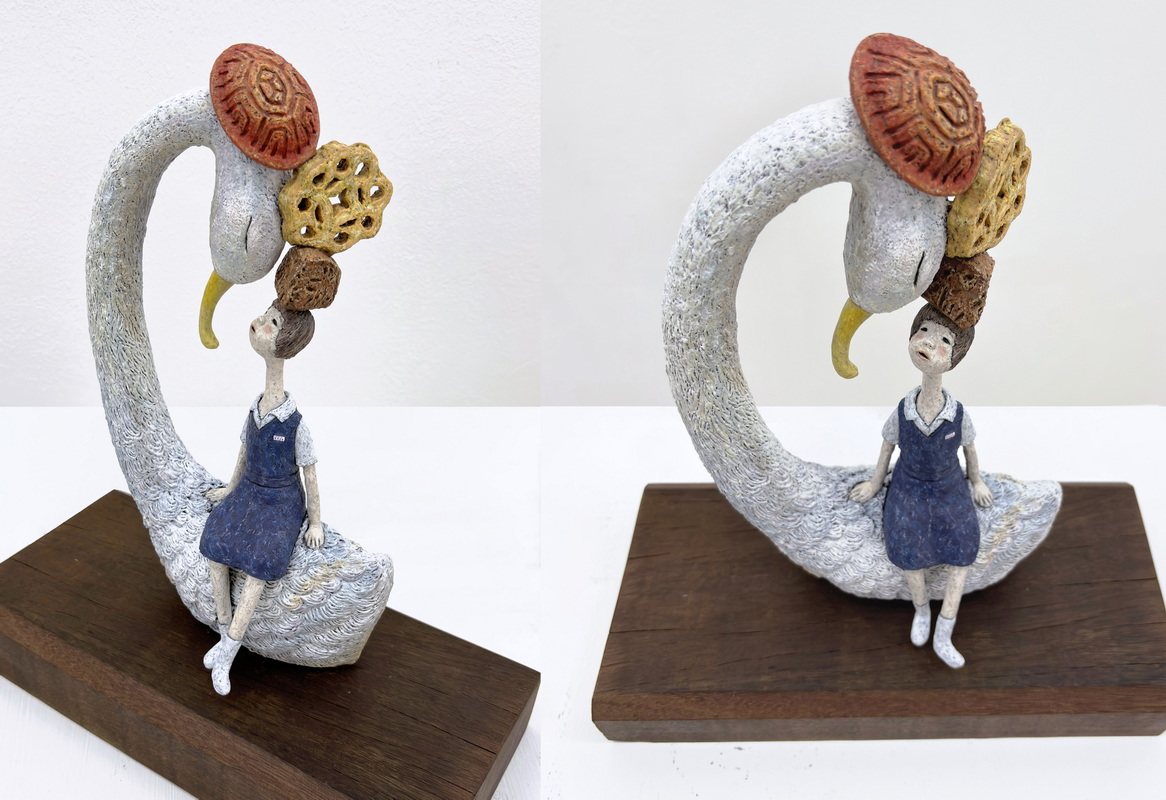
The Taste Within II
(Variety Angles)
Yiji Lee Sou Ven
35(H) x 30(W) x 14.5(D)cm
Stone Powder Clay & Mixed Media
2025
Yiji reflects on food as a multigenerational symbol of love, a quiet and everyday ritual that preserves both identity and intimacy. Through the tactile medium of ceramics, she gives material form to these memories, inviting reflection on how personal narratives shape and enrich Malaysia’s collective cultural landscape. The labour-intensive and deliberate process of sculpting mirrors the care and intention found in food preparation. Both are acts of preservation that safeguard Chinese culinary heritage. Once rooted in familial tradition, these foods have now become a shared part of the Malaysian palate, underscoring how personal identity and collective culture are constantly evolving, blending and being redefined.
The Taste Within II
(Variety Angles)
Yiji Lee Sou Ven
35(H) x 30(W) x 14.5(D)cm
Stone Powder Clay & Mixed Media
2025
Yiji reflects on food as a multigenerational symbol of love, a quiet and everyday ritual that preserves both identity and intimacy. Through the tactile medium of ceramics, she gives material form to these memories, inviting reflection on how personal narratives shape and enrich Malaysia’s collective cultural landscape. The labour-intensive and deliberate process of sculpting mirrors the care and intention found in food preparation. Both are acts of preservation that safeguard Chinese culinary heritage. Once rooted in familial tradition, these foods have now become a shared part of the Malaysian palate, underscoring how personal identity and collective culture are constantly evolving, blending and being redefined.
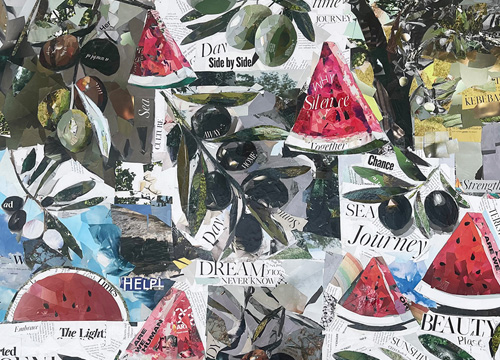

'Dari Sungai ke Segara' (From the River to the Sea)
Anisa Abdullah
91 x 91 cm
Paper Collage on Canvas
2024
Kemerdekaan Malaysia was not realised without the struggles of the past. As we celebrate our independence, this artwork reminds us that unity and freedom are hard-earned and must be continuously protected. Our celebration isn’t blind to the struggles faced by others around the world; instead, it reflects the values we share, peace, justice and the strength of community. It stands as a quiet yet powerful reminder of what our nation has achieved and what we must continue to uphold.
The artwork enriches the narrative of Merdeka Month, showing that our celebration of unity isn't blind to global struggles. Instead, it reinforces the idea that freedom and peace are not to be taken for granted and that Malaysians stand in solidarity with all who seek them.
'Dari Sungai ke Segara' (From the River to the Sea)
Anisa Abdullah
91 x 91 cm
Paper Collage on Canvas
2024
Kemerdekaan Malaysia was not realised without the struggles of the past. As we celebrate our independence, this artwork reminds us that unity and freedom are hard-earned and must be continuously protected. Our celebration isn’t blind to the struggles faced by others around the world; instead, it reflects the values we share, peace, justice and the strength of community. It stands as a quiet yet powerful reminder of what our nation has achieved and what we must continue to uphold.
The artwork enriches the narrative of Merdeka Month, showing that our celebration of unity isn't blind to global struggles. Instead, it reinforces the idea that freedom and peace are not to be taken for granted and that Malaysians stand in solidarity with all who seek them.

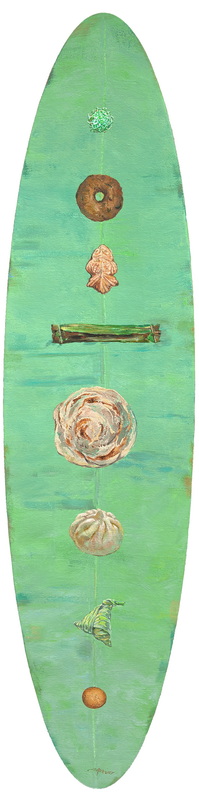
Teh Time Story I
Calvin Chua
163 x 40.5cm
Acrylic on Linen
2025
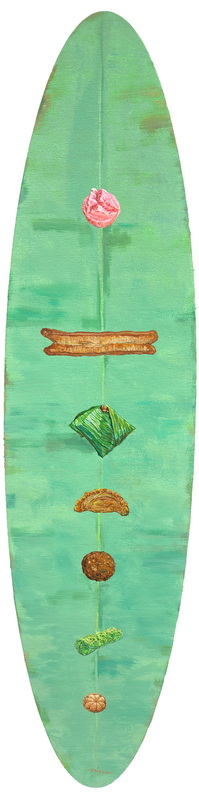
Teh Time Story I & II by Calvin Chua is a playful celebration of Malaysian kuih muih, carefully arranged on a banana leaf. The composition mimics the look of a surfboard, adding a sense of movement and fun, as if the treats themselves are riding a wave of joy.
Traditionally, banana leaves are used to serve hearty rice meals with an array of rich dishes. Here, Chua subverts that expectation by replacing the usual feast with colourful, bite-sized kuih. The contrast creates a whimsical visual twist, one that highlights the joy, nostalgia and cultural richness of Malaysian snacks.
Teh Time Story I
Calvin Chua
163 x 40.5cm
Acrylic on Linen
2025
Teh Time Story I & II by Calvin Chua is a playful celebration of Malaysian kuih muih, carefully arranged on a banana leaf. The composition mimics the look of a surfboard, adding a sense of movement and fun, as if the treats themselves are riding a wave of joy.
Traditionally, banana leaves are used to serve hearty rice meals with an array of rich dishes. Here, Chua subverts that expectation by replacing the usual feast with colourful, bite-sized kuih. The contrast creates a whimsical visual twist, one that highlights the joy, nostalgia and cultural richness of Malaysian snacks.

Teh Time Story II
Calvin Chua
163 x 40.5cm
Acrylic on Linen
2025
Teh Time Story I & II by Calvin Chua is a playful celebration of Malaysian kuih muih, carefully arranged on a banana leaf. The composition mimics the look of a surfboard, adding a sense of movement and fun, as if the treats themselves are riding a wave of joy.
Traditionally, banana leaves are used to serve hearty rice meals with an array of rich dishes. Here, Chua subverts that expectation by replacing the usual feast with colourful, bite-sized kuih. The contrast creates a whimsical visual twist, one that highlights the joy, nostalgia and cultural richness of Malaysian snacks.
Teh Time Story II
Calvin Chua
163 x 40.5cm
Acrylic on Linen
2025
Teh Time Story I & II by Calvin Chua is a playful celebration of Malaysian kuih muih, carefully arranged on a banana leaf. The composition mimics the look of a surfboard, adding a sense of movement and fun, as if the treats themselves are riding a wave of joy.
Traditionally, banana leaves are used to serve hearty rice meals with an array of rich dishes. Here, Chua subverts that expectation by replacing the usual feast with colourful, bite-sized kuih. The contrast creates a whimsical visual twist, one that highlights the joy, nostalgia and cultural richness of Malaysian snacks.
The Silhouette That Holds Us
Issarezal Ismail
56 x 75cm
Graphite on Acid Free Paper
2025
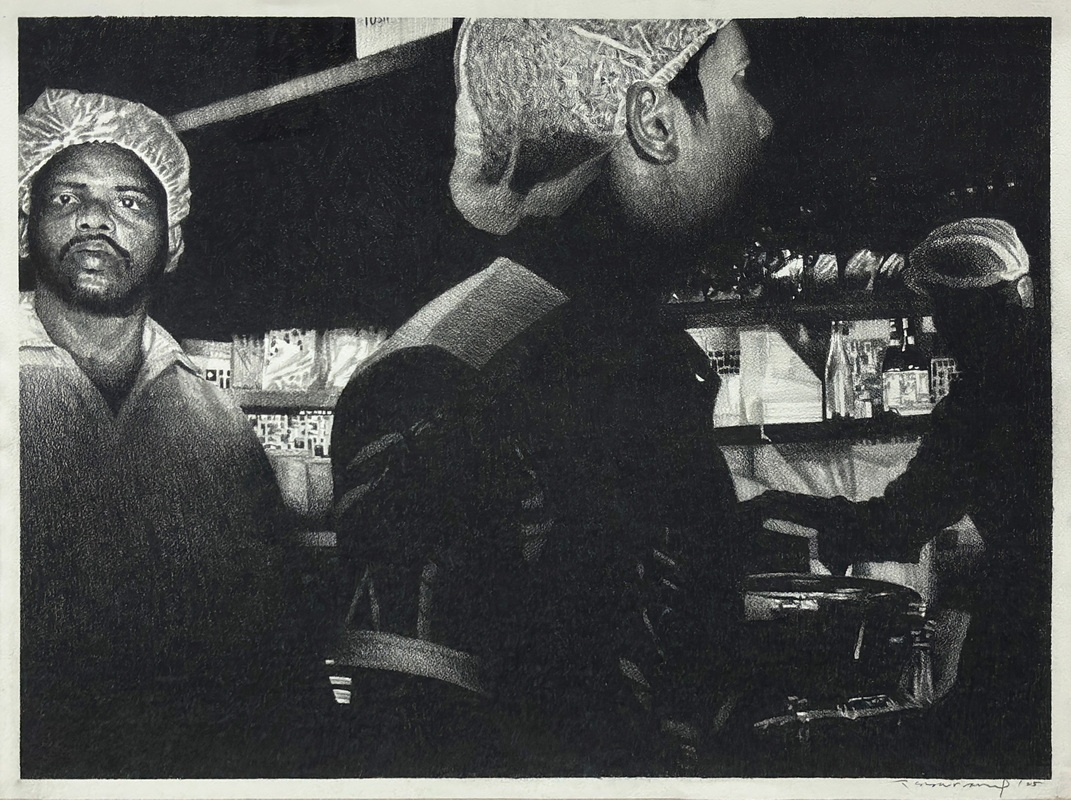
The Silhouette That Holds Us reflects on the kedai mamak as a symbol of shared space, cultural exchange, and everyday unity in Malaysia. More than just a place to eat, the mamak is where people from all walks of life gather, interact, and find a sense of belonging. This work invites viewers to consider how such communal spaces are shaped not only by human presence, but also by the often unseen labour and quiet rhythms that sustain them, through moments of care, effort and connection that form the invisible threads of togetherness.
The Silhouette That Holds Us
Issarezal Ismail
56 x 75cm
Graphite on Acid Free Paper
2025
The Silhouette That Holds Us reflects on the kedai mamak as a symbol of shared space, cultural exchange, and everyday unity in Malaysia. More than just a place to eat, the mamak is where people from all walks of life gather, interact, and find a sense of belonging. This work invites viewers to consider how such communal spaces are shaped not only by human presence, but also by the often unseen labour and quiet rhythms that sustain them, through moments of care, effort and connection that form the invisible threads of togetherness.
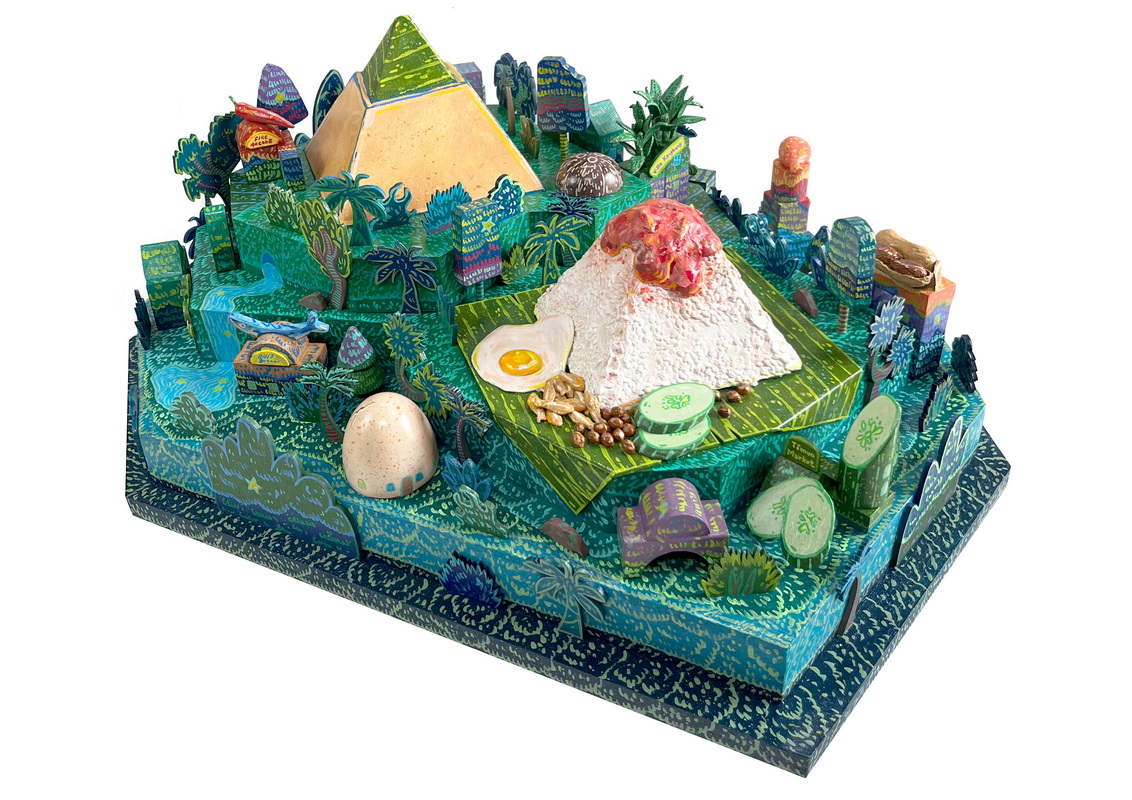
The Taste of Home
Aimman Hafizal
30(H) x 52(W) x 72(D)cm
Acrylic Paint on 3D Print & Wood
2025
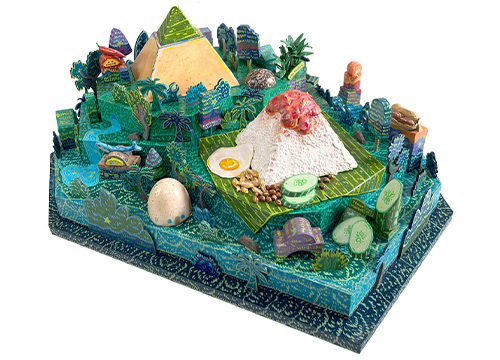
“The Taste of Home’’ is a sculptural universe shaped by my childhood breakfasts, where my mom's nasi lemak was always the sunshine on my plate. This island reimagines nasi lemak as a living archipelago, with rice mountains and bustling towns, celebrating how a humble meal can unite us beyond taste; into memory, identity and home. Created in celebration of Merdeka month, this artwork honours Malaysia’s diversity through a breakfast that nourished my dreams, reminding us that food is more than sustenance, but it’s also a way to remember who we are.
The Taste of Home
Aimman Hafizal
30(H) x 52(W) x 72(D)cm
Acrylic Paint on 3D Print & Wood
2025
“The Taste of Home’’ is a sculptural universe shaped by my childhood breakfasts, where my mom's nasi lemak was always the sunshine on my plate. This island reimagines nasi lemak as a living archipelago, with rice mountains and bustling towns, celebrating how a humble meal can unite us beyond taste; into memory, identity and home. Created in celebration of Merdeka month, this artwork honours Malaysia’s diversity through a breakfast that nourished my dreams, reminding us that food is more than sustenance, but it’s also a way to remember who we are.
Sneaky Snacky (Senyap-senyap Ngap!)
Amy Nazira
122 x 91.5cm
Oil on Canvas
2025
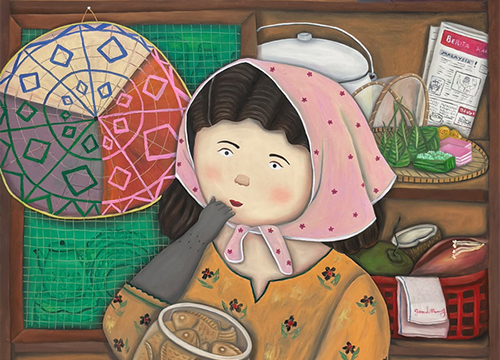
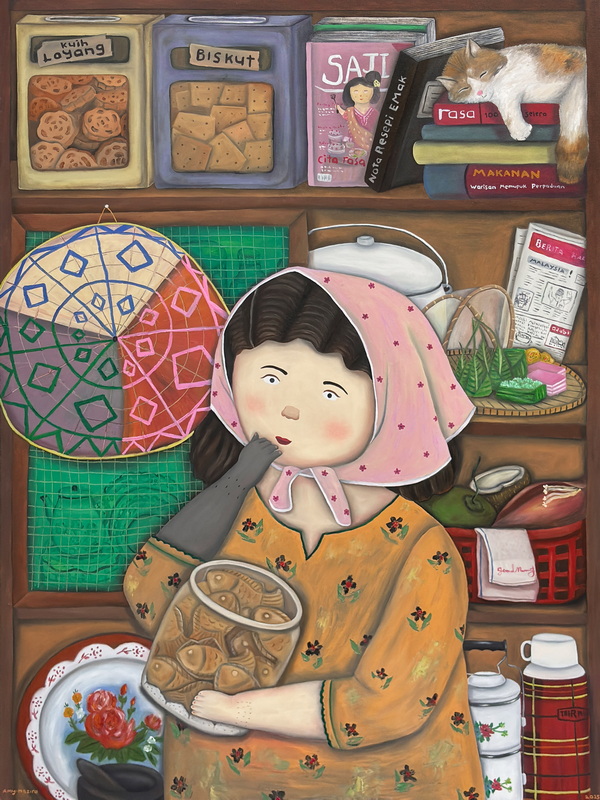
In Sneaky Snacky (Senyap-senyap Ngap!), Amy Nazira captures a quietly mischievous moment many Malaysians know well, the irresistible urge to snatch a kuih or cookie from the jar when no one is looking. The classic square biscuit jar, often seen in the corner of a kedai runcit in the kampung, becomes a portal to childhood memories. It is a familiar sight during festive seasons, when the air smells of Milo, margarine and laughter. Nearby, recipe books like Resepi Emak (Mom’s recipe notes) highlight the passing of culinary knowledge from one generation to the next, preserving family traditions and treasured food heritage.
Sneaky Snacky (Senyap-senyap Ngap!)
Amy Nazira
122 x 91.5cm
Oil on Canvas
2025
In Sneaky Snacky (Senyap-senyap Ngap!), Amy Nazira captures a quietly mischievous moment many Malaysians know well, the irresistible urge to snatch a kuih or cookie from the jar when no one is looking. The classic square biscuit jar, often seen in the corner of a kedai runcit in the kampung, becomes a portal to childhood memories. It is a familiar sight during festive seasons, when the air smells of Milo, margarine and laughter. Nearby, recipe books like Resepi Emak (Mom’s recipe notes) highlight the passing of culinary knowledge from one generation to the next, preserving family traditions and treasured food heritage.
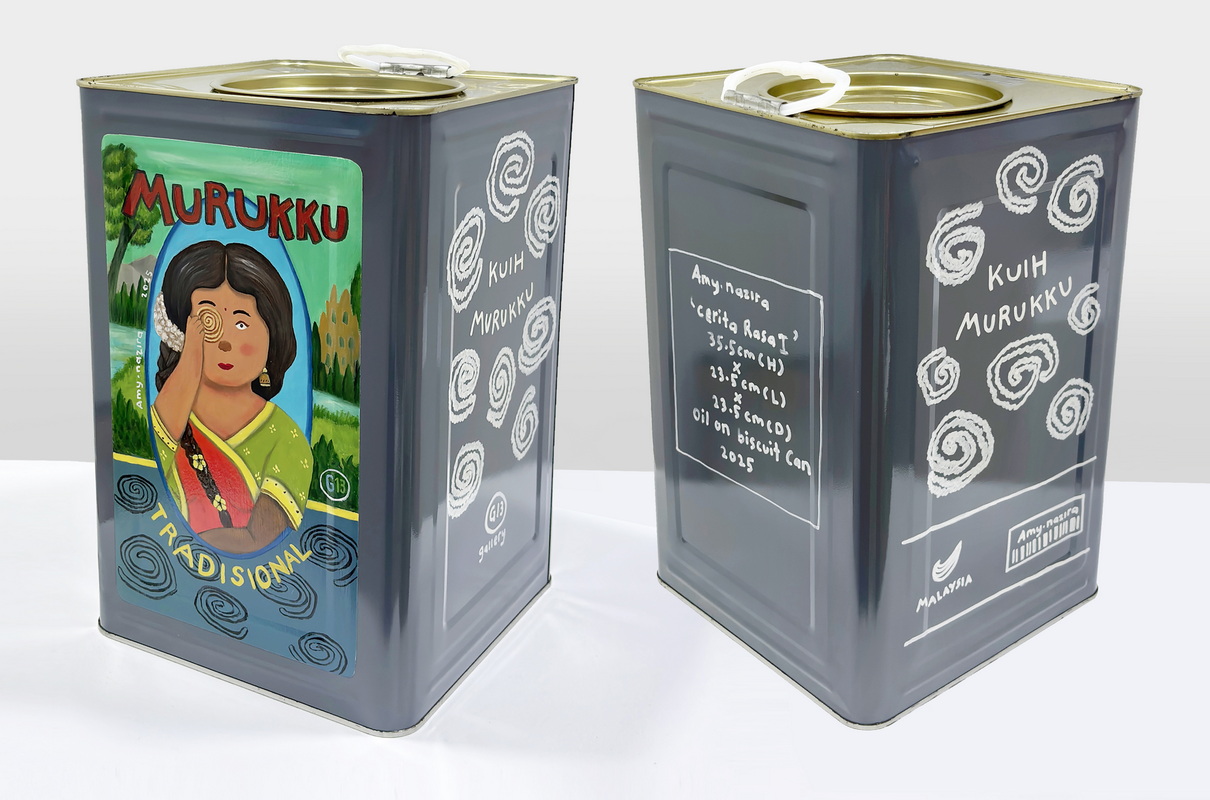
Cerita Rasa I
Amy Nazira
35.5(H) x 23.5(W) x 23.5(D)cm
Oil on Biscuit Can
2025
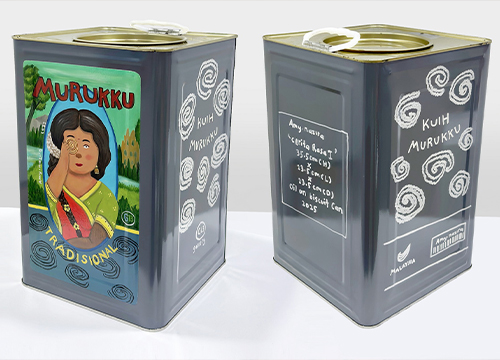
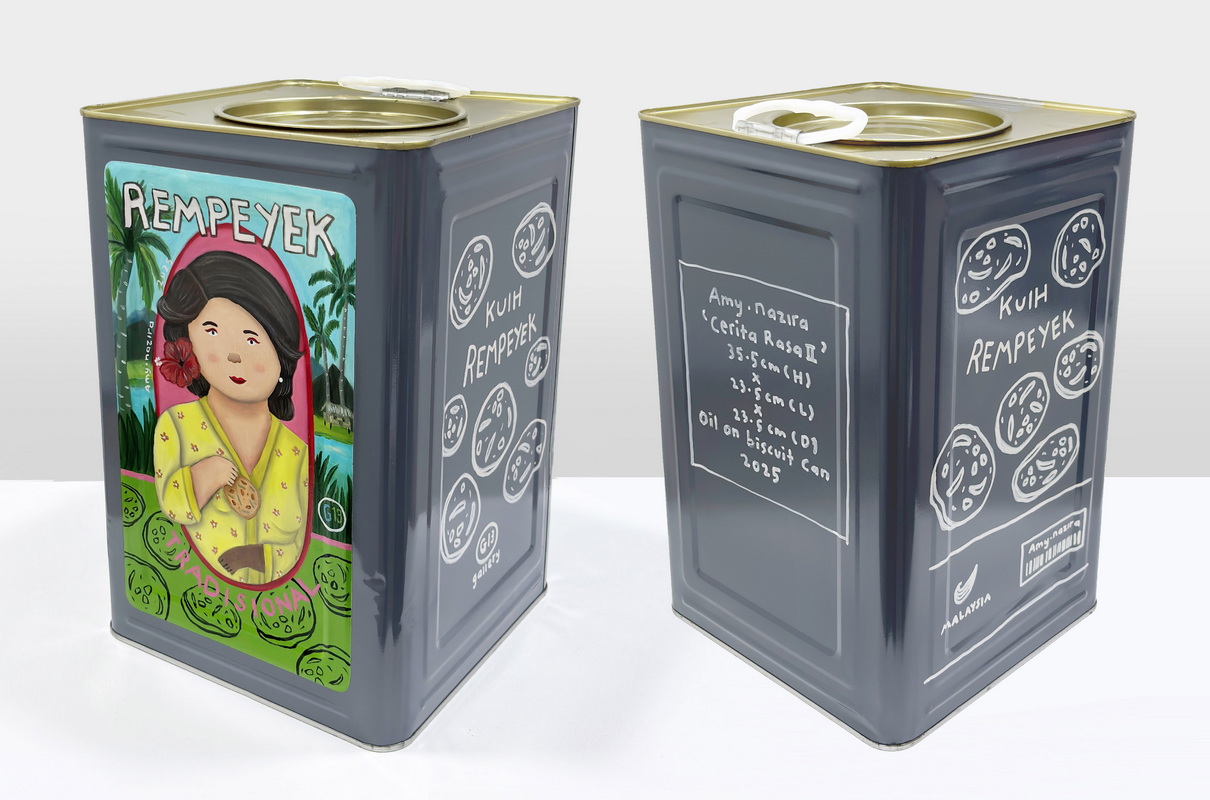
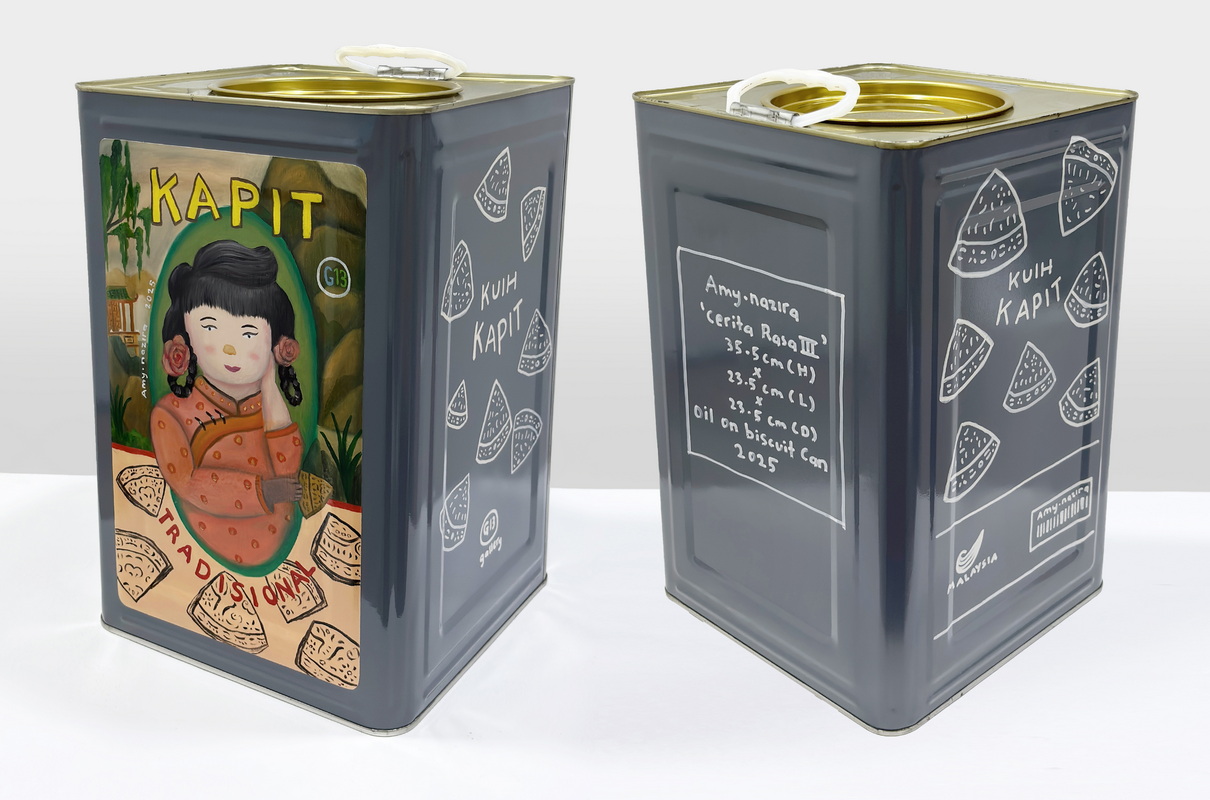
Sometimes, identity doesn’t speak, it tastes, it smells, it lingers. Amy Nazira’s Cerita Rasa series draws on the sensory power of food to recall the quiet beauty of Malaysia’s multicultural roots, nestled in the corners of kitchens and the hearts of families. her work is a visual archive of a nation where Malay, Chinese and Indian cultures live side by side, bound by festive flavours, childhood rituals, and that familiar old biscuit tin. Through the intimate lens of food, family and tradition, Amy celebrates the everyday unity that defines Malaysian life where heritage is preserved not just through words, but through recipes, aromas and shared memories across races and generations.
Cerita Rasa I
Amy Nazira
35.5(H) x 23.5(W) x 23.5(D)cm
Oil on Biscuit Can
2025
Sometimes, identity doesn’t speak, it tastes, it smells, it lingers. Amy Nazira’s Cerita Rasa series draws on the sensory power of food to recall the quiet beauty of Malaysia’s multicultural roots, nestled in the corners of kitchens and the hearts of families. her work is a visual archive of a nation where Malay, Chinese and Indian cultures live side by side, bound by festive flavours, childhood rituals, and that familiar old biscuit tin. Through the intimate lens of food, family and tradition, Amy celebrates the everyday unity that defines Malaysian life where heritage is preserved not just through words, but through recipes, aromas and shared memories across races and generations.

Click to view Artist Profile
- Aimman Hafizal
- Anisa Abdullah
- Amy Nazira
- Chong Ai Lei
- Fawwaz Sukri
- Gan Sze Hooi
- GAN TEE SHENG
- Haziq Syawal
- Ho Mei Kei
- Izzuddin Basiron
- Kow Leong Kiang
- Khairudin Zainudin
- NIK MOHD SHAHFIZ
- Noor Zahran
- Syed Fakaruddin
- Wong Ming Hao
- Yuki Tham
- Amar Shahid
- Azzaha Ibrahim
- Azizan Paiman
- Calvin Chua
- Gabriel Cheah
- Gan Chin Lee
- Issarezal Ismail
- Sack Tin Lim
- Yiji Lee Sou Ven